United Nations humanitarian agencies are warning that escalating violence across the Middle East is triggering new waves of displacement, straining aid systems and threatening to destabilize an already fragile region.
“This is a moment of grave peril right now,” said Tom Fletcher, UN Under-Secretary-General for Humanitarian Affairs and Emergency Relief Coordinator and head of the UN Office for the Coordination of Humanitarian Affairs (OCHA). “We’re seeing these crises escalate rapidly with consequences that are out of control.” He spoke on March 6, just one week after the U.S. and Israel began operations against Iran, which have since spread across the region.
UN Secretary-General António Guterres issued a similar warning later in the day, cautioning that the situation could quickly spiral.
“All the unlawful attacks in the Middle East and beyond are causing tremendous suffering and harm to civilians throughout the region,” Guterres said. “The situation could spiral beyond anyone’s control. It is time to stop the fighting and get to serious diplomatic negotiations.”
“The situation could spiral beyond anyone’s control. It is time to stop the fighting and get to serious diplomatic negotiations.”
António Guterres
Across the region, UN agencies, including the UN Refugee Agency (UNHCR), the World Food Programme (WFP), the UN Children’s Fund (UNICEF) and the International Organization for Migration (IOM) are mobilizing emergency responses as displacement rises and humanitarian needs grow.
UN agencies are providing regular situation reports to the public. Data below is compiled from WFP (Emergency Response Situation Report, March 8), UNHCR (Emergency Flash Update, March 5) and OCHA (Syria Humanitarian Response, March 4). Many countries affected are not represented herein due to a lack of information. This resource is current as of Sunday, March 8.
Iran: Internal Displacement Rising
Iran, which already hosts more than 1.65 million refugees and people in need of international protection, is now experiencing significant internal displacement as the conflict escalates.
According to the Government of Iran and UNHCR, roughly 100,000 people have left Tehran since the start of the conflict, many moving toward rural areas. Humanitarian officials caution that the real number of people on the move may be considerably higher as families leave major cities amid rising insecurity.
Authorities have reported more than 1,000 deaths and damage to over 100 civilian sites, while UN agencies estimate that around 100,000 people have been newly displaced within the past week.
Despite the deteriorating security environment, UNHCR offices across Iran remain operational, though access in some locations has been limited due to explosions, heightened security checkpoints and movement restrictions affecting staff. In some cases, personnel have shifted temporarily to remote work arrangements to maintain core protection services.
Refugees continue to seek assistance. UNHCR reports that helplines are overwhelmed with calls, primarily from refugees who say they have lost their livelihoods and are seeking emergency financial support. Others are requesting resettlement abroad, which many see as their only immediate protection option. UNHCR continues to provide counselling and protection services to refugees, including assistance for children, survivors of gender-based violence and other vulnerable individuals.
For now, large-scale cross-border refugee flows out of Iran have not materialized. Border crossings between Iran and Iraq remain open but operate under restrictions, generally allowing Iraqi nationals to enter Iraq and Iranian nationals to return to Iran. UNHCR teams are maintaining contingency plans in case the conflict triggers larger population movements.
Meanwhile, WFP continues providing assistance to approximately 33,000 refugees in Iran, including Afghan refugees living in settlements across the country.
Of the 20 refugee settlements supported by WFP, eight host WFP-supported bakeries producing around 25,000 loaves of bread each day, supplying roughly 75 percent of the refugee population. In smaller settlements hosting about 8,300 people, WFP distributes wheat flour and supports home-based bread baking.
Current wheat flour stocks are sufficient to sustain food assistance through the end of April, according to WFP.
Lebanon: Shelters Filling
Lebanon is facing one of the most immediate humanitarian pressures in the region.
Following evacuation orders and ongoing airstrikes, more than 102,000 people have been displaced across the country. Government authorities report that 484 shelters are now operating, with 431 at maximum capacity.
Even before the latest escalation, Lebanon’s humanitarian situation was already dire. WFP estimates that 874,000 people in the country lack reliable access to food.
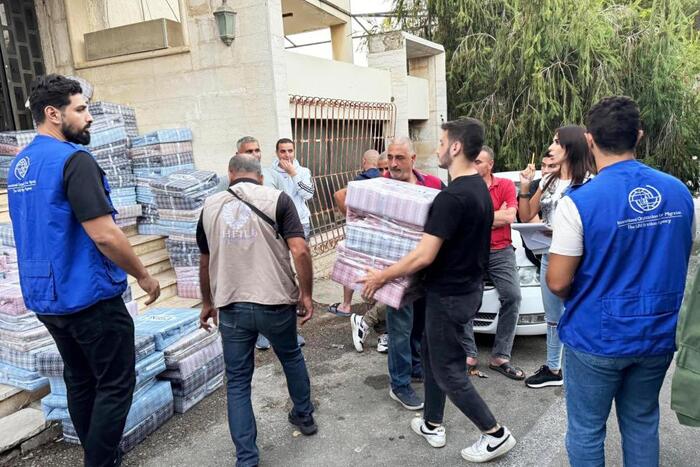
Humanitarian agencies are rapidly scaling up assistance. UNHCR and its partners have distributed emergency relief items, including blankets, mattresses and other essential supplies, to more than 6,000 displaced people across 26 shelters.
At the same time, WFP has delivered food assistance to about 40,300 displaced people across 159 shelters, providing hot meals, ready-to-eat rations and bread.
In coordination with Lebanon’s Ministry of Social Affairs, WFP has also launched emergency cash transfers reaching roughly 183,200 people, using the country’s shock-responsive social safety net to support families displaced by the violence.
Additional food stocks have been mobilized through WFP’s emergency preparedness system. About 404 metric tons of ready-to-eat food supplies were dispatched from Türkiye to support the response.
The conflict is also disrupting support for children. Nationwide school closures have forced the suspension of WFP’s school meals program, interrupting a key source of nutrition for vulnerable students.
Protection concerns are growing as shelters fill to capacity and host communities already under strain struggle to absorb new arrivals. Refugees and migrants face particular difficulties accessing safe accommodation and humanitarian monitors report rising tensions in some areas.
Some refugees have begun expressing interest in returning to Syria despite ongoing risks – an indication of the mounting pressure inside Lebanon.
“Civilians must be protected – full stop.”
Tom Fletcher
Families Crossing Back into Syria
As conditions worsen in Lebanon, increasing numbers of people are crossing the border into Syria.
Syrian authorities report that more than 67,000 Syrian families and over 6,000 Lebanese nationals have crossed from Lebanon into Syria in recent days, primarily through the Masnaa and Jousieh border crossings.
Many families are arriving with whatever belongings they can carry, many in trucks loaded with household goods and others with little more than the clothes they are wearing.
UNHCR teams are present at the Jdeidet Yabous and Joussieh crossings to monitor arrivals, assess protection needs and coordinate assistance with Syrian authorities and humanitarian partners.
Emergency aid is being provided to vulnerable families. WFP has also distributed more than 17,000 emergency food bars to people crossing the border.
Gaza: Aid Access Still Severely Restricted
Humanitarian operations in Gaza remain under severe strain. Although the Kerem Shalom crossing has reopened, other crossings, including Rafah, remain closed, limiting the flow of humanitarian goods.
Fuel deliveries remain critically low. Aid agencies have been able to bring in less than one million liters of fuel this week, far below the two million liters required to maintain essential services.
According to WFP, bakeries currently have fuel reserves to operate for roughly two weeks. If humanitarian access does not improve, the agency warns it may have to cut food rations to just 25 percent of daily nutritional requirements for approximately 1.3 million people.
Food insecurity is already worsening. In Gaza’s markets, flour prices reportedly rose by 270 percent in just two days as households began stockpiling food amid uncertainty.
Funding Gaps Threaten the Response
Even as humanitarian needs surge, UN agencies warn that funding shortages threaten their ability to respond. UNHCR operations across the region remain severely underfunded, including:
- Lebanon: 14% funded against a $472 million appeal
- Iraq: 28% funded against a $61 million requirement
- Syria: 28% funded against a $324 million appeal
- Türkiye and Armenia: roughly 42% funded
Without additional resources, humanitarian officials warn that the region could face a “crisis within a crisis” if displacement accelerates.
At the same time, Fletcher warned that escalating violence risks diverting attention from other humanitarian emergencies – from Sudan and South Sudan to Ukraine and the Democratic Republic of Congo.
For now, UN agencies across the region – including OCHA, UNHCR, WFP, UNICEF and IOM – are working to maintain assistance for civilians caught in the conflict while preparing for the possibility that the crisis could expand further.
“What we need is de-escalation, an immediate cessation of hostilities and genuine dialogue and negotiations.”
Tom Fletcher