As military strikes ripple across Iran and the wider Middle East, a dangerous question hangs in the air: what happens if a nuclear facility is caught in the crossfire?
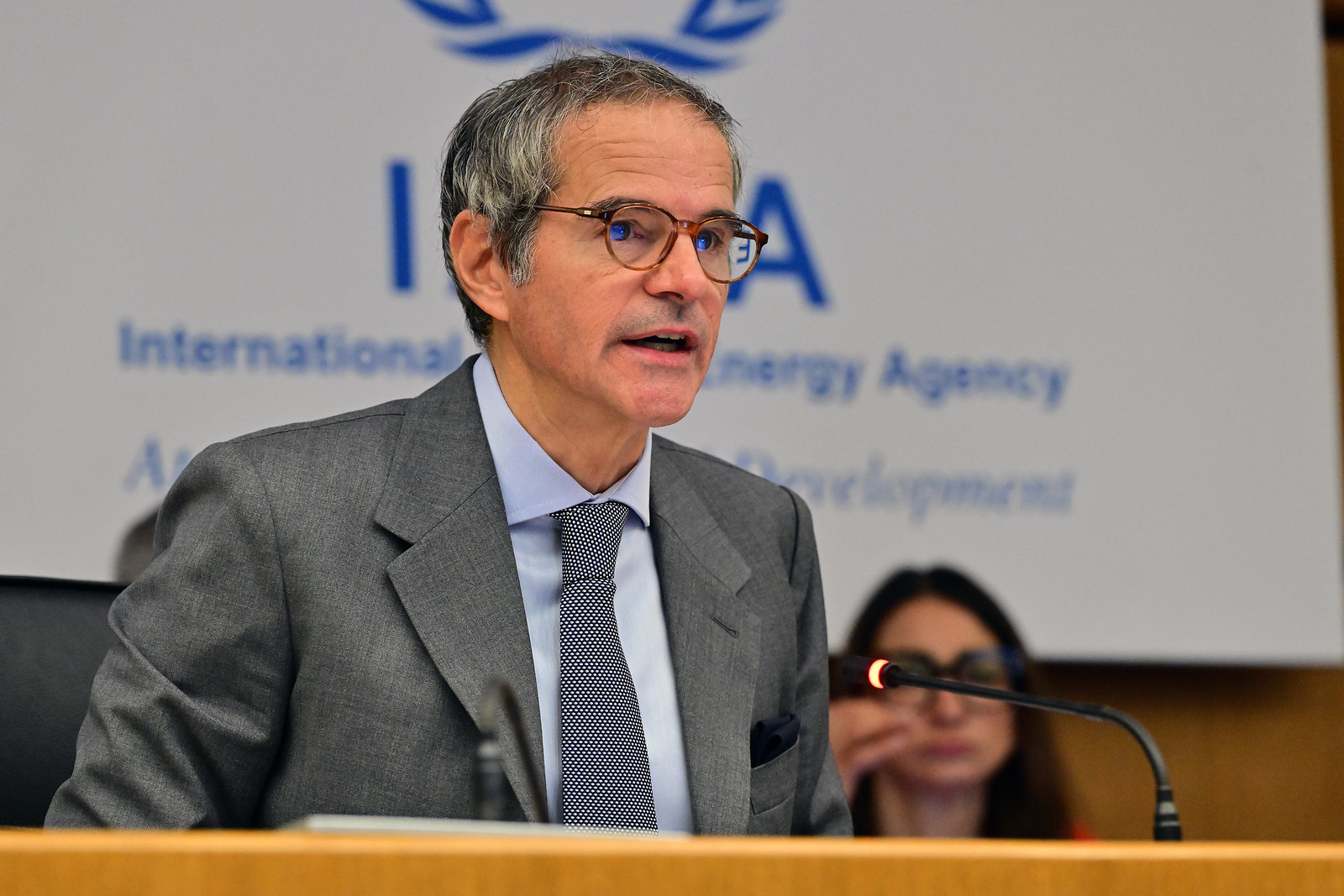
So far, the world’s nuclear watchdog says the region has avoided the worst-case scenario. Radiation monitoring systems have detected “no elevation of radiation levels above the usual background levels” in countries bordering Iran, according to Rafael Grossi, head of the International Atomic Energy Agency.
Radiation monitoring systems have detected “no elevation of radiation levels above the usual background levels” in countries bordering Iran.
Just as important, Grossi told the IAEA Board of Governors in Vienna on Monday, March 2, inspectors currently have “no indication that any of the nuclear installations… have been damaged or hit.”
But the margin for error is thin.
Even without confirmed damage to nuclear infrastructure, Grossi warned that the risks posed by an expanding regional conflict are serious. Military strikes near nuclear facilities, he cautioned, could quickly escalate into something far more dangerous.
“The situation today is very concerning,” Grossi added, warning that a radiological release with serious consequences cannot be ruled out if the conflict spreads or critical infrastructure is damaged.
Monitoring the Situation
The Agency’s Incident and Emergency Centre has been activated and is now operating continuously, collecting real-time data and coordinating with regional safety networks as the conflict unfolds.
While satellite imagery shows activity around several Iranian nuclear sites, Grossi emphasized that nothing observed so far resembles previous confirmed attacks on nuclear facilities in the region.
At the same time, the IAEA has not yet been able to fully restore routine technical communications with Iran’s nuclear regulatory authorities through its emergency channels. Diplomatic contacts remain intact, but the regular exchange of safety data has been disrupted. The Agency says it continues working to restore those technical lines.
The IAEA has not yet been able to fully restore routine technical communications with Iran’s nuclear regulatory authorities through its emergency channels.
Diplomacy: “Hard, Never Impossible”
Even as the military situation evolves, Grossi stressed that diplomacy remains the only durable solution to the nuclear dispute surrounding Iran’s program.
“The lasting solution to this long-existing discord lies on the diplomatic table,” he said. “Diplomacy is hard, but it is never impossible. Nuclear diplomacy is even harder, but it is never impossible.”
In a press conference following Monday’s Board meeting, Grossi noted that he recently participated in consultations aimed at resolving tensions around Iran’s nuclear program, providing IAEA’s technical expertise to negotiators. Although those talks did not produce an agreement, the Agency stands ready to support future diplomatic efforts whenever they resume.
“It is not a matter of if, but of when we will again gather at that diplomatic table,” Grossi added.
“It is not a matter of if, but of when we will again gather at that diplomatic table.”
Uncertainty Around Iran’s Nuclear Program
Separately, an IAEA report released days before the meeting highlighted continuing uncertainty about Iran’s nuclear activities following the 12-day war between Iran and Israel in June 2025.
Because inspectors have not been granted access to several facilities, the agency says it “cannot provide any information on the current size, composition or whereabouts of the stockpile of enriched uranium in Iran,” warning that the “loss of continuity of knowledge… needs to be addressed with the utmost urgency.”
The IAEA says it “cannot provide any information on the current size, composition or whereabouts of the stockpile of enriched uranium in Iran.”
Under the Treaty on the Non-Proliferation of Nuclear Weapons (NPT), Iran is obligated to cooperate with inspectors, though Tehran curtailed cooperation following the war.
According to IAEA reports, Iran operates four declared enrichment facilities and currently possesses about 972 pounds of uranium enriched to 60 percent purity, close to weapons-grade levels at 90 percent. Grossi warned that, if further enriched, the stockpile could theoretically provide enough fissile material for as many as ten nuclear weapons, though he stressed that does not mean Iran currently possesses a bomb.
With access limited, the IAEA has increasingly relied on satellite imagery. Recent images of the Isfahan nuclear complex – just over 200 miles southeast of Tehran – show “regular vehicular activity” near a tunnel system believed to store enriched uranium.
The report notes that Iran did allow inspectors to visit several unaffected facilities at least once since June 2025, with the exception of a power plant under construction at Karun.
Regional Nuclear Infrastructure
The broader regional context also raises the stakes.
The Middle East now includes several countries with nuclear power or research capabilities. The United Arab Emirates operates four nuclear reactors, while Jordan and Syria maintain research reactors. Israel, not a party to the NPT, is widely believed to possess over 90 nuclear warheads, though the country neither acknowledges nor denies the existence of an arsenal. Other states in the region use nuclear materials for medical, industrial and research purposes.
In this environment, longstanding IAEA resolutions warning against attacks on nuclear facilities carry renewed relevance. Damage to reactors, enrichment plants or storage sites could produce cross-border radiological consequences.
IAEA’s Technical Role
It is critical to underscore that the IAEA’s role is technical, not political.
Decisions about military action are made by governments based on their own intelligence and national security assessments. The IAEA’s mandate is to verify nuclear material, monitor safeguards compliance and assess nuclear safety risks.
The IAEA’s role is technical, not political… to verify nuclear material, monitor safeguards compliance and assess nuclear safety risks.
What Comes Next
The IAEA, Grossi said, will remain on alert. The Agency will “continue to monitor the situation” and stands ready to support governments if nuclear safety or security is threatened.
“What I can assure you,” he said, “is that the IAEA is there – keeping the international community informed and ready to react immediately if a breach in nuclear safety occurs.”
Update on March 4: Since the publication of this article on March 3, the IAEA confirmed the Natanz nuclear enrichment facility, located outside of Qom, Iran, suffered “some damage” at entrance buildings to the underground fuel enrichment plant. A statement issued on Wednesday, March 4, stressed that, “No radiological consequence expected and no additional impact detected at FEP itself.” The Natanz facility was among the sites severely damaged during the 12-day war between Iran and Israel in 2025.