
Every month, dozens of St. Peterburg, Florida residents of all ages can be found in a local park, doing push-ups, practicing balancing and kick boxing at the direction of personal trainer and former Army vet Tii Wood.
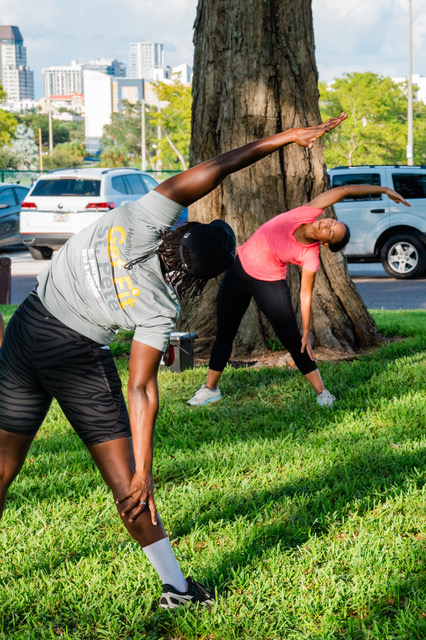 The free class is one of two dozen fitness courses offered by Healthy St. Pete, a decade-old city-wide program that provides free fitness, nutrition, mental health, youth and health education classes to the city’s 3,400 employees and 260,000 residents. And it was spurred, in part, by research from the World Health Organization.
Healthy St. Pete was spearheaded in 2015 by then deputy mayor Kanika Tomalin, PhD, who was inspired in part to create the program based on WHO research and data showing the positive health outcomes of health system and community investments in health access and prevention.
“When I was doing my doctoral work on the Affordable Care Act and the impact it would have on Florida’s hospitals, much of my research and background was informed by the WHO,” said Tomalin, who is now the CEO of the Foundation for a Healthy St. Pete, a non-profit that supports access to health. “They had evidence of the difference that expanded access to care and prevention can have on the health of a population. So we applied those ideas when creating initiatives such as Healthy St. Pete and our employee wellness program.”
And the city has continued to use WHO data over the past decade to help inform and maintain programs that are offered under Healthy St. Pete, says Kim Lehto, Healthy St. Pete coordinator.
“WHO data is evidence-based, which is really important in driving our programing and help us measure its success.”
“WHO data is evidence-based, which is really important in driving our programing and help us measure its success,” said Lehto. “It helps us demonstrate to our community that we are using best practices backed up with evidence showing their positive impact.”
 For example, the WHO has collected hundreds of clinical studies showing that regular physical activity reduces cancer by 8 to 28 percent, heart disease and stroke by 19 percent, diabetes by 17 percent, depression and dementia by 28 percent to 32 percent. For that reason, Healthy St Pete has made providing accessible and fun fitness classes, like Wood’s class, available to residents.
“Among the biggest benefits of this program is not only the exercise but that it has been helping people in the community make significant connections with one another,” said Wood. “People who come to these classes throw birthday parties for one another and get together outside of class. When I started teaching these classes, I was new to town, so it’s been a great way for me to make friendships, too.”
“Among the biggest benefits of this program is not only the exercise, but that it has been helping people in the community make significant connections with one another.”
Healthy St. Pete is also currently working on an effort to expand access to healthy and fresh food in underserved areas of the city. It is another program that is backed up, in part, with WHO data.
“Through collaborative efforts, partnerships and data, like that from the WHO, we are able to seek additional funding and expanding programs and offerings to our city’s residents,” said Lehto.