On January 7, the White House issued an Executive Order directing the United States to withdraw from 31 United Nations agencies. These include entities that are the cornerstones of efforts to protect health, support democracy and good governance, combat climate change and protect children from armed conflict.
As the Better World Campaign underscored in a post following the announcement, we’re deeply concerned about these withdrawals, which mark a significant shift in how the U.S. engages in and funds multilateral institutions. The UN Secretary-General stressed at the time that, “assessed contributions to United Nations regular budget and peacekeeping budget, as approved by the General Assembly, are a legal obligation under the UN Charter for all Member States, including the United States.” Continued nonpayment to the UN regular and peacekeeping budgets – including through withdrawing from UN entities – undermines America’s standing across the entire UN system, as well as our ability to shape outcomes that advance U.S. interests and save lives.
Below, we break down each of the affected agencies, how they’re funded – whether through the UN regular budget or voluntary contributions – and what withdrawal means for U.S. influence and engagement at the UN.
Note that this is a rapidly evolving situation, and information below may change as more details emerge. As of January 8, the UN had not been officially notified of the withdrawals. Updates will be reflected here as we learn more.
Funding Totals and Sources for Impacted Agencies
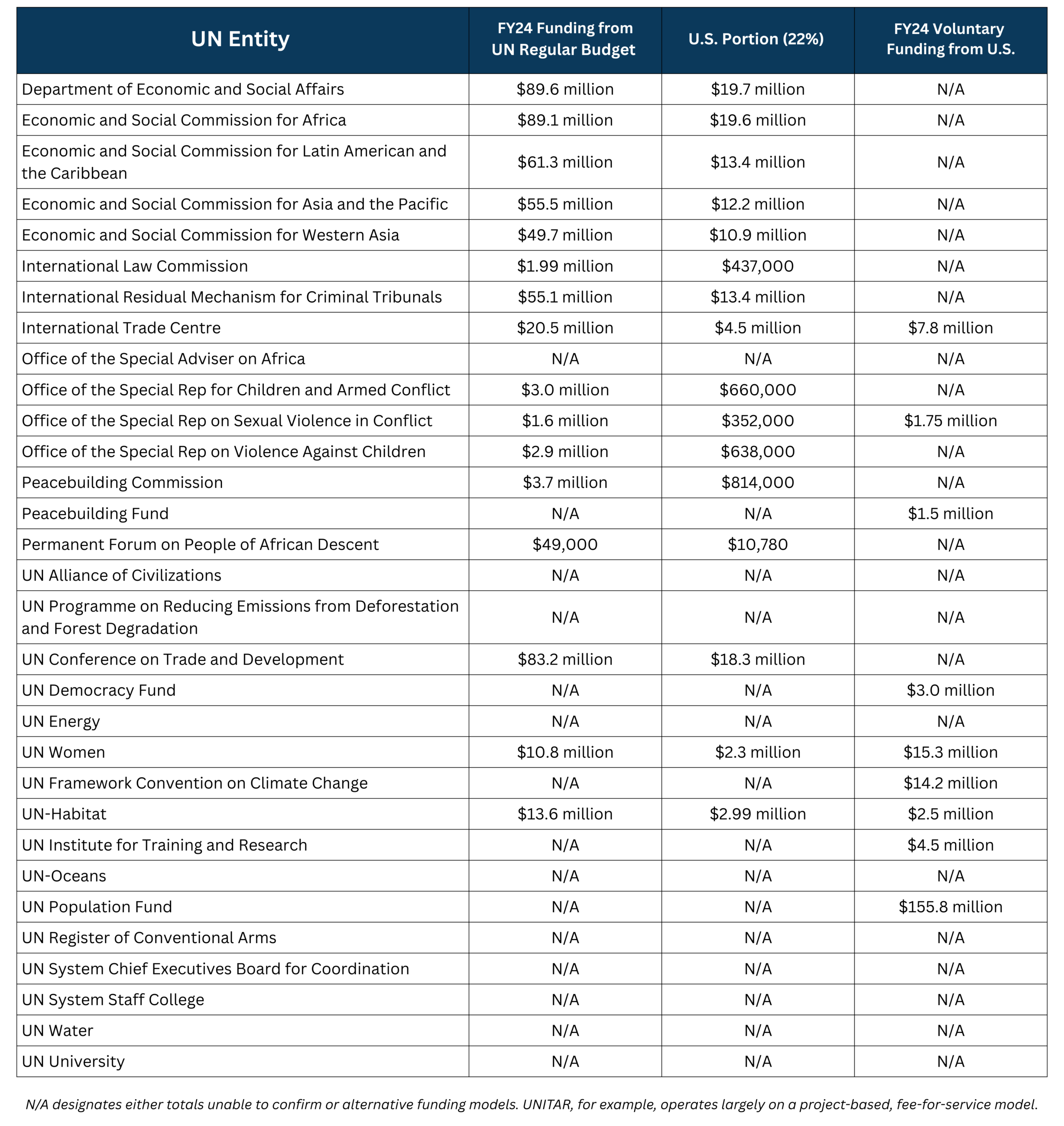
A Note on Funding: In recent years, U.S. assessments for the UN regular budget, peacekeeping operations and specialized agencies account for between $2-3 billion annually (for context, this is less than the state budget of Rhode Island). Although numbers above reflect U.S. obligations, as of January 2026, the U.S. has yet to pay its FY25 assessed contributions to the UN regular budget, and has only paid 30% of peacekeeping obligations. We’ve also greatly reduced support for programs related to humanitarian assistance, health and development. All other developed countries have paid their fair share of membership dues. Learn more about the UN budget here.
What These Entities Do – And Why They Matter
Department of Economic and Social Affairs: DESA is the UN’s data and policy hub on development, population trends and public administration. U.S. agencies and lawmakers rely on its statistics to shape evidence-based policies on everything from urban planning to disaster preparedness. Of note, withdrawing from DESA is not possible because it is not a separate “organization” one withdraws from; rather, it’s a core component of the UN Secretariat. Defunding only cedes the ground to other nations.
Economic and Social Commission for Africa: ECA advises African governments on economic growth, trade integration and climate resilience. Its work helps stabilize key U.S. partners and reduce the drivers of conflict and migration.
Economic and Social Commission for Latin America and the Caribbean: ECLAC provides economic research on growth and fiscal policy in the Americas. Its analysis informs regional stability and supports U.S. economic and security interests in the Western Hemisphere.
Economic and Social Commission for Asia and the Pacific: ESCAP works on infrastructure, disaster risk reduction and digital connectivity across the world’s most populous region. Its programs help reduce disaster impacts and strengthen trade and supply-chain resilience.
Economic and Social Commission for Western Asia: ESCWA supports economic reform, data collection and policy coordination in the Middle East and North Africa. Its efforts contribute to regional stability in a part of the world central to U.S. security and energy interests.
International Law Commission: ILC develops international legal rules that govern diplomacy, maritime law and treaties. These frameworks protect U.S. interests by providing predictability and legal grounding for American engagement abroad.
International Residual Mechanism for Criminal Tribunals: IRMCT handles remaining war crimes cases from Rwanda and the former Yugoslavia, ensuring accountability for atrocities and reinforcing global norms that deter future conflicts.
International Trade Centre: ITC helps developing countries meet international trade standards and integrate into global markets. This work expands export opportunities, strengthens supply chains and supports fair competition for U.S. businesses.
Office of the Special Adviser on Africa: OSAA supports coordinated international engagement in political and development issues affecting Africa, a region where U.S. diplomatic, economic and security interests are growing.
Office of the Special Representative of the Secretary-General for Children in Armed Conflict: CAAC documents the recruitment and abuse of children in war zones and presses armed groups to stop. Its work supports U.S. efforts to protect civilians and uphold human rights in conflict areas.
Office of the Special Representative on Sexual Violence in Conflict: SVC works to prevent rape and abuse used as weapons of war and supports survivors. Their reporting can play an essential role in shaping the agenda of the Security Council. For example, the Council’s authorization of the peace operation in Haiti was partly driven by reporting on sexual violence in Haiti’s conflict.
Office of the Special Representative on Violence Against Children: SRSG-VAC addresses abuse and exploitation of children worldwide beyond war zones. Strong child protection systems reduce long-term instability and humanitarian crises. Withdrawal damages U.S. credibility on human rights issues and contravenes bipartisan U.S. support for these issues historically.
Peacebuilding Commission: PBC brings together donors and governments to support countries emerging from conflict. Preventing relapse into violence saves U.S. taxpayers the far higher cost of future interventions.
Peacebuilding Fund: PBF provides fast flexible funding for fragile states before crises escalate. Early investment helps avoid costlier emergencies that often require U.S. involvement.
Permanent Forum on People of African Descent: PFPAD addresses racial discrimination and development challenges worldwide. Its work supports inclusive societies that are more stable and economically resilient.
UN Alliance of Civilizations: UNAOC promotes dialogue across cultures and religions to counter extremism. These efforts support U.S. national security by reducing polarization and radicalization risks.
UN Programme on Reducing Emissions from Deforestation and Forest Degradation: REDD+ helps countries protect forests through climate finance and sustainable land use. Forest protection supports global climate stability and U.S. environmental interests.
UN Conference on Trade and Development: UNCTAD provides research on trade debt and investment policy, supporting fairer global markets that benefit U.S. businesses and workers.
UN Democracy Fund: UNDEF finances grassroots projects that strengthen democratic institutions.
UN Energy: UN-Energy coordinates UN efforts on clean and affordable energy access. Energy stability abroad supports global markets and U.S. economic security.
UN Women: UN Women leads global efforts on gender equality and violence prevention. Empowering women improves economic growth and stability in U.S. partner countries.
UN Framework Convention on Climate Change: UNFCCC oversees global climate negotiations, including the Paris Agreement. It provides the framework for managing climate risks that affect U.S. infrastructure agriculture and national security.
UN Human Settlements Programme: UN-Habitat focuses on sustainable cities housing and urban planning. Better urban governance abroad reduces humanitarian crises and migration pressures.
UN Institute for Training and Research: UNITAR trains diplomats civil servants and emergency responders worldwide. Stronger governance and crisis response abroad mean fewer costly emergencies.
UN Oceans: UN-Oceans coordinates global action on marine pollution fisheries and conservation. Healthy oceans protect U.S. coastal economies, food security and maritime interests.
UN Population Fund: UNFPA supports maternal health reproductive care and population data. Healthier populations reduce humanitarian instability and disease risks that can spill across borders.
UN Register of Conventional Arms: UNROCA promotes transparency in global arms transfers. It helps prevent weapons from fueling conflicts that could threaten security.
UN System Chief Executives Board for Coordination: CEB aligns strategy budgets and policy priorities across UN agencies. This coordination means more efficient use of U.S. contributions.
UN System Staff College: UNSSC trains UN personnel on leadership and crisis coordination, leading to better-trained responders who, in turn, improve outcomes in emergencies where the U.S. has strategic interests.
UN Water: UN-Water coordinates global efforts on freshwater access sanitation and water management, helping reduce conflict risk and humanitarian crises.
UN University: UNU conducts research on peace sustainability and technology. Its work informs smarter global policies that support U.S. security and innovation goals.