This is an evolving situation. Updates will be provided as new information is available.
In the wake of coordinated U.S. and Israeli attacks on Iran on February 28, 2026, which struck military sites and senior leadership of the Iranian regime, tensions throughout the Middle East are rapidly escalating. Iran has responded with a wave of drone and missile attacks across the region, with strikes verified in Israel and several Gulf states.
At the request of French President Emmanuel Macron, the UN Security Council convened an emergency session just hours after the attacks began. The meeting offered a snapshot of global reaction: a divided international response marked by caution from allies, sharp criticism from rivals and widespread concern about the risk of regional war.
Washington’s Position
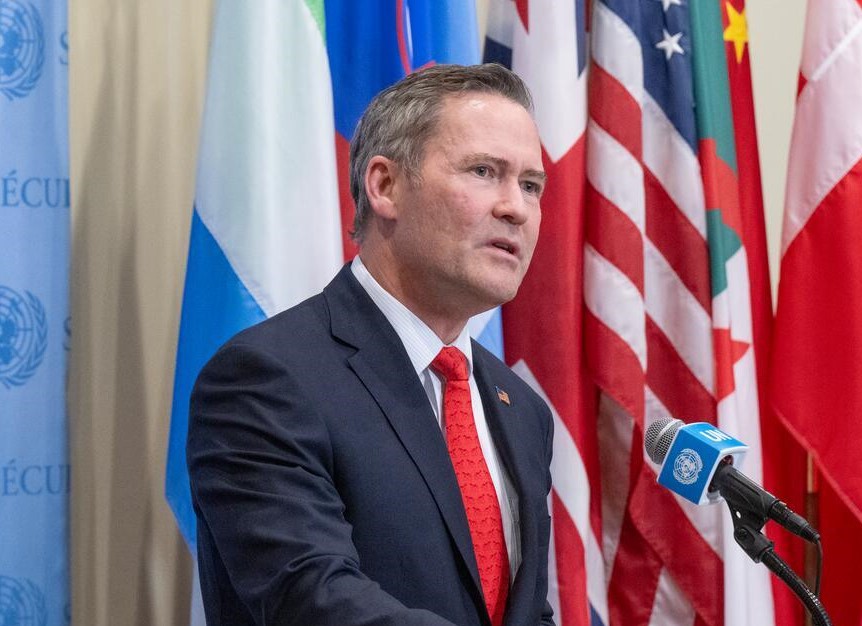
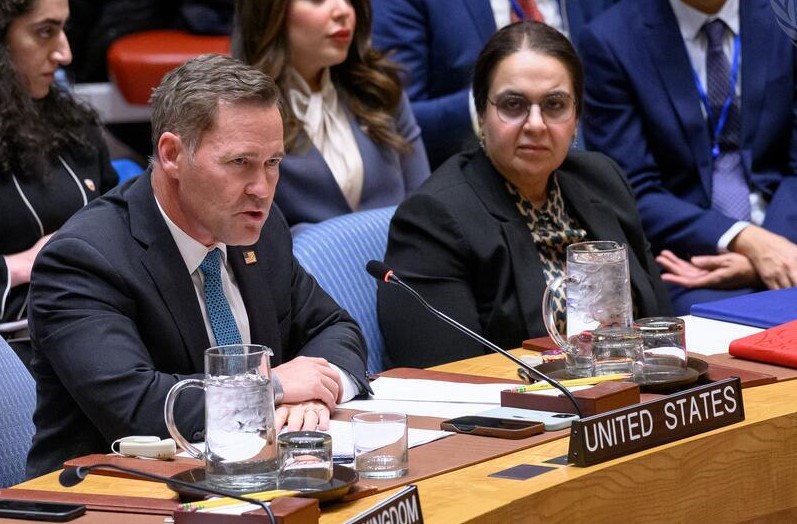
U.S. Ambassador Mike Waltz defended the operation as a necessary response to long-standing security threats posed by Iran. (Read his unabridged remarks here.)
“The most fundamental duty of any sovereign government is the protection of its people,” he stressed. Waltz repeated the words of President Trump, who released a video earlier in the day, saying, “To the proud, great people of Iran. I saw tonight that the hour of your freedom is at hand.”
“The most fundamental duty of any sovereign government is the protection of its people.”
U.S. Ambassador Mike Waltz
Waltz reiterated that the strikes were designed to dismantle ballistic missile capabilities, degrade naval assets used to disrupt international shipping and weaken networks supporting proxy militias, specifically that of the Houthis, Hezbollah and Hamas. Preventing Iran from acquiring a nuclear weapon, he said, was the central objective.
“No responsible nation can ignore persistent aggression and violence,” Waltz told the Council, citing decades of attacks on U.S. personnel, allies and maritime commerce.
He closed by saying, “Peace is preserved through strength in the face of terror. History has taught us that the cost of inaction is far greater than the burden of decisive action, and our President, President Trump, has taken that decisive action today.”
Israel’s ambassador, Danny Danon, echoed Waltz’s position, describing the operation as a last resort after repeated diplomatic efforts stalled.
“Israel stands before you today… to confront and stop an existential threat before it became irreversible,” Danon said.
Both governments framed their actions as lawful self-defense under Article 51 of the UN Charter.
Iran’s Response
Iran’s ambassador, Amir-Saeid Iravani, rejected those claims, calling the strikes “an unprovoked and premeditated aggression.”
“This is not only an act of aggression; it is a war crime and a crime against humanity,” Iravani said, accusing the U.S. and Israel of deliberately targeting civilian areas.
Iravani argued that self-defense claims lack legal foundation and insisted Iran’s retaliatory strikes were a legitimate response, similarly citing Article 51. He also claimed Western countries were applying a “double standard” by condemning Iran’s response while avoiding criticism of the initial strikes.
“A Grave Threat”
Secretary-General António Guterres focused on regional reverberation. At the time of the meeting, Iran’s response included retaliatory rockets targeting Bahrain, Saudi Arabia, Qatar, the United Arab Emirates, Kuwait and Jordan. Airspace closures, internet blackouts and disruptions to shipping through the Strait of Hormuz underscored the risk of global economic fallout, while reports of civilian casualties intensified international concern.
“We are witnessing a grave threat to international peace and security,” Guterres told the Council in his opening statement, warning that the conflict could ignite “a chain of events that no one can control in the most volatile region of the world.”
Perhaps most troubling for UN officials, the events occurred amid ongoing negotiations between Washington and Tehran mediated by Oman. Talks were expected to resume in Vienna in early March, but the situation casts doubt on whether those diplomatic channels will remain open.
Europe’s Balancing Act
France, Denmark, Greece, Latvia and the U.K. all expressed deep concern about escalation and civilian harm, with France, Germany and the U.K. issuing a joint statement condemning Iran for retaliatory attacks against neighbors in the Gulf.
France warned that the situation was “dangerous for everyone” and urged an immediate halt to hostilities, while criticizing Iran’s nuclear program and lack of cooperation with international inspectors.
The United Kingdom’s representative emphasized regional stability as the priority and condemned Iran’s retaliatory strikes across neighboring states. Underscoring they did not participate in the initial attacks, the ambassador did state that U.K. forces were “active and British planes in the sky… as part of coordinated regional defensive operations.”
The overall tone suggested unease with the escalation coupled with reluctance to break with Washington.
Criticism from China and Russia
In contrast, China and Russia sharply condemned the strikes.
China described the operation as “brazen,” emphasizing that Iran’s sovereignty “must be respected” and urging an immediate cessation of military action.
Russia called the attacks an “unprovoked act of armed aggression against a sovereign and independent UN Member State,” warning that they risked triggering a humanitarian and economic catastrophe.
Pakistan also condemned the strikes as violations of international law while simultaneously criticizing Iran’s attacks on Gulf states – a position reflecting concern about alignment with either side.
Several Global South countries focused primarily on civilian protection and the need to uphold principles of the UN Charter, warning that reprisals were replacing diplomacy.
Gulf States Offer Nuanced View
Representatives from Gulf countries emphasized that Iran’s response had expanded the conflict far beyond its original participants.
Bahrain described missile strikes on civilian infrastructure and residential areas as “a grave threat to international and regional peace and security.” As with other Arab states, they cautioned that the attacks could disrupt air navigation, maritime trade and energy flows.
Representing the League of Arab States, Ambassador Abdulaziz Al-Shamsi linked the crisis to the broader Israeli-Palestinian conflict, warning that the “Arab-Israeli conflict has expanded into a full-scale regional war.” He accused Israel of escalating militarily to “prevent the establishment of an independent Palestinian state.”
Fear of Wider War and Calls for Diplomacy
Despite sharp divisions, one theme united nearly all speakers: alarm at the possibility of regional war.
Diplomats warned of cascading risks, including escalation involving additional states, proxy warfare and humanitarian consequences for civilians. “Sustainable peace can only be achieved through diplomacy, not through force,” Somalia’s representative said on behalf of several African members.
Even countries critical of Iran’s behavior insisted that negotiations remain the only viable long-term solution.
What Comes Next
The Council took no formal action – an anticipated outcome given the United States’ veto power as a permanent member. Still, the debate underscored allies’ alignment with Washington against the backdrop of calls for de-escalation to prevent a regional war.
“Peace is preserved through strength in the face of terror. History has taught us that the cost of inaction is far greater than the burden of decisive action.”
U.S. Ambassador Mike Waltz
Representatives Present (listed in order of formal remarks)
- UN Secretary-General António Guterres
- France: Ambassador Jérôme Bonnafont
- Bahrain: Ambassador Jamal Fares Al-Ruwaie
- Russia: Ambassador Vassily Nebenzia
- China: Ambassador Fu Cong
- Colombia: Ambassador Leonor Zalabata Torres
- U.S.: Ambassador Mike Waltz
- Denmark: Ambassador Christina Markus Lassen
- Pakistan: Ambassador Asim Iftikhar Ahmad
- Greece: Ambassador Aglaia Balta
- Somalia: Deputy Ambassador Mohamed Rabi Yusuf
- Panama: Ambassador Eloy Alfaro De Alba
- Latvia: Ambassador Sanita Pavļuta-Deslandes
- U.K.: Ambassador James Kariuki (Security Council President)
- Iran: Ambassador Amir-Saeid Iravani
- Israel: Ambassador Danny Danon
- United Arab Emirates: Abdulaziz Nasser Al-Shamsi (on behalf of the League of Arab States)
Remarks from the Secretary-General
Prior to the meeting, UN Secretary-General António Guterres issued the following statement:
I condemn today’s military escalation in the Middle East. The use of force by the United States and Israel against Iran, and the subsequent retaliation by Iran across the region, undermine international peace and security.
All Member States must respect their obligations under international law, including the Charter of the United Nations. The Charter clearly prohibits “the threat of the use of force against the territorial integrity or political independence of any state, or in any other manner inconsistent with the Purposes of the United Nations.”
I call for an immediate cessation of hostilities and de-escalation. Failing to do so risks a wider regional conflict with grave consequences for civilians and regional stability. I strongly encourage all parties to return immediately to the negotiating table.
I reiterate that there is no viable alternative to the peaceful settlement of international disputes, in full accordance with international law, including the UN Charter. The Charter provides the foundation for the maintenance of international peace and security.
Related Links
- Get to know Article 2 of the UN Charter
- Why the Strait of Hormuz matters
- Learn about the UN’s humanitarian work inside Iran