While Operation Absolute Resolve put Venezuela in the global spotlight, it also ignited a broader debate among diplomats and legal experts about the United Nations Charter – its origins, its limits and what happens when those limits are tested.
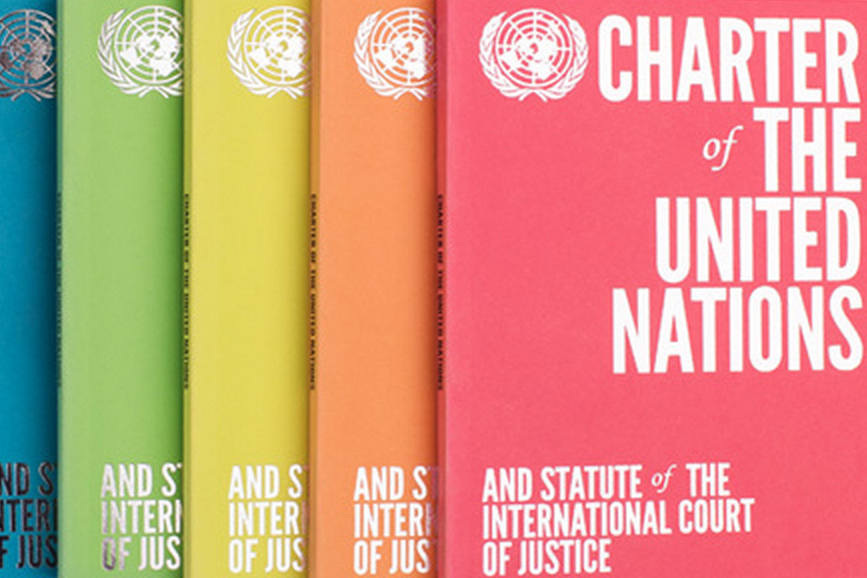
To understand what’s at stake, it helps to see the Charter for what it was designed to be: a kind of international constitution that helps nations work well together.
National Security at a Global Scale
Adopted in 1945, the UN Charter is the founding document of the United Nations, and its roots are deeply American. President Franklin D. Roosevelt helped shape its principles through the 1941 Atlantic Charter with Winston Churchill, envisioning a postwar world built on collective security rather than perpetual war.
When the Charter was presented in San Francisco, the U.S. Senate ratified it by an overwhelming 89-2 vote. This was not idealistic globalism, but calculated national security strategy – designed to create rules strong enough to restrain aggression before U.S. troops were pulled into another catastrophic conflict.
The UN Charter was national security strategy designed to restrain aggression before U.S. troops were pulled into another catastrophic conflict.
Legally, the Charter is a treaty incorporated into U.S. law through Senate ratification and the President’s signature. Functionally, it sets out shared rules for how states interact, defines strict limits on the use of military force and creates institutions (the Security Council, the General Assembly and the International Court of Justice) to manage disputes.
The Rule Everyone’s Talking About
Lately, when people talk about “violating the Charter,” they’re often referring to Article 2(4), which states: “All Members shall refrain in their international relations from the threat or use of force against the territorial integrity or political independence of any state, or in any other manner inconsistent with the Purposes of the United Nations.”
In plain terms: respect borders.
Not every border incident qualifies as a violation. Accidental or isolated infractions, or limited law enforcement actions that breach sovereignty, may cross physical – but not legal – thresholds. Article 2(4) is typically triggered when military force becomes serious: bombing another state’s infrastructure, engaging another state’s armed forces or occupying another territory.
When Force Is Allowed
When that line is crossed, the Charter permits military action in a couple circumstances.
Article 51
First: self-defense, preserved in Article 51.
When sovereignty is violated by an armed attack, a state may respond, but the response must be necessary and proportionate. Collective self-defense – when other nations join in – requires a request from the attacked state so as not to violate sovereignty themselves.
In recent years, Article 51 has become increasingly central and controversial. Some states argue self-defense is lawful only after an actual attack occurs. Others, led largely by the U.S. and its allies, argue that force may also be justified in cases of imminent threat and against non-state actors operating with a state’s protection. Since 2021, Article 51 has been invoked at least 78 times.
The Security Council plays a critical role here, as Article 51 requires states to report self-defense actions. These reports help other governments assess legality and shape international law through precedent.
Chapter VII
Second: Security Council authorization under Chapter VII.
When the Council determines that a situation threatens international peace – not just one country’s security – it can authorize measures that may include military force as a last resort, usually beginning with political and economic tools. Any action must still be necessary, proportionate and aimed at restoring peace and security.
Historically, the Council was cautious about explicitly invoking Chapter VII. Its intent was often inferred from language and context. The first explicit Chapter VII action appeared in 1968 during debates over Southern Rhodesia, reflecting political divisions over sanctions and force.
In recent decades, practice has become more mixed. Some resolutions rely on Chapter VII without naming it. Others cite it directly to avoid ambiguity. At times, the language is used mainly for political signaling, while some Chapter VII resolutions include non-mandatory terms like “urges” or “calls upon.” The result is ongoing debate over which decisions are legally binding and how far Chapter VII authority extends.
What Happens When a Violation Occurs?
The UN has no global police force, so Charter violations are addressed through diplomacy, sanctions, international courts and political pressure – both through UN bodies and individual states.
The process usually begins with non-military tools authorized under Article 41, including economic sanctions, asset freezes, travel bans, arms embargoes and diplomatic restrictions. The Council can also establish monitoring committees, expert panels and, in rare cases, international tribunals, such as those created after the wars in the former Yugoslavia and Rwanda.
If non-military measures fail, Chapter VII allows for collective military action, though this is used sparingly. Even then, enforcement depends less on a standing UN force, which the UN lacks –peacekeepers are contributed voluntarily by Member States – and more on the willingness of countries to act. States implement sanctions through their own laws, while UN committees monitor compliance and report back to the Council. The system works best when major powers are aligned. When permanent members disagree or use their veto power, enforcement can stall.
In the end, the Charter provides the legal tools. Political will determines how far they go.
Humanitarian Intervention
The moral case for using force to stop atrocities is powerful. The legal case gets a bit more contested.
After Rwanda and Kosovo, the UN embraced the Responsibility to Protect framework, or R2P – but it also reaffirmed one core rule: only the Security Council can authorize the use of force. A handful of countries still argue for a narrow right to intervene when catastrophe looms. Most remain wary, concerned that “humanitarian” can too easily become a cover for politics.
R2P fits squarely within the Charter’s collective security system. It says states must protect their own people from genocide, war crimes, ethnic cleansing and crimes against humanity. If they fail, the international community should try diplomacy and humanitarian pressure first. If that isn’t enough, Chapter VII gives the Security Council the authority to act – including, if necessary, with force.
Why Justification Matters
One of the Charter’s most important effects is that it forces governments to explain themselves. Even when states use force, they almost always justify their actions in Charter terms – self-defense, consent or collective security.
Those explanations may be contested, but the act of justifying matters. It reinforces the idea that rules exist, legitimacy flows through them and precedent shapes future behavior.
Any Gray Areas?
Like all fields of law, yes.
Modern conflicts complicate the picture. Large-scale terrorist attacks by non-state actors may qualify as armed attacks, allowing self-defense if there’s evidence another state provided material or tacit support. But legal experts warn that lowering the threshold too far risks turning the Charter into a permissive system rather than a restraining one.
Then there’s “violation by proxy,” a concept the International Court of Justice addressed in its landmark 1986 Nicaragua v. United States decision. The Court made clear that a state can violate the Charter’s prohibition on force even without sending its own troops across a border. Providing critical support to armed groups – including arming, training or directing insurgents – can amount to an unlawful “armed attack.” In other words: you don’t need boots on the ground to cross the line.
Why the Charter Still Matters
Like all living constitutions, the UN Charter faces the challenges of its time and must continue to adapt.
But the bottom line remains the same: the Charter matters. Because at its core, it’s designed to raise the political cost of aggression, narrow the legal justifications for force and preserve collective security as the default.
The Charter raises the political cost of aggression, narrows the legal justifications for force and preserves collective security as the default.