Two years ago, we interviewed BWC Executive Director Jordie Hannum about his travels to Ukraine during the war. At the fourth anniversary of Russia’s full-scale invasion, we checked back in to assess where things stand.
Q: When we first spoke, you described Ukraine’s national mood as resilient. Does that still feel true today?
Four words: frozen river dance parties! That is, in the capital of Kyiv.
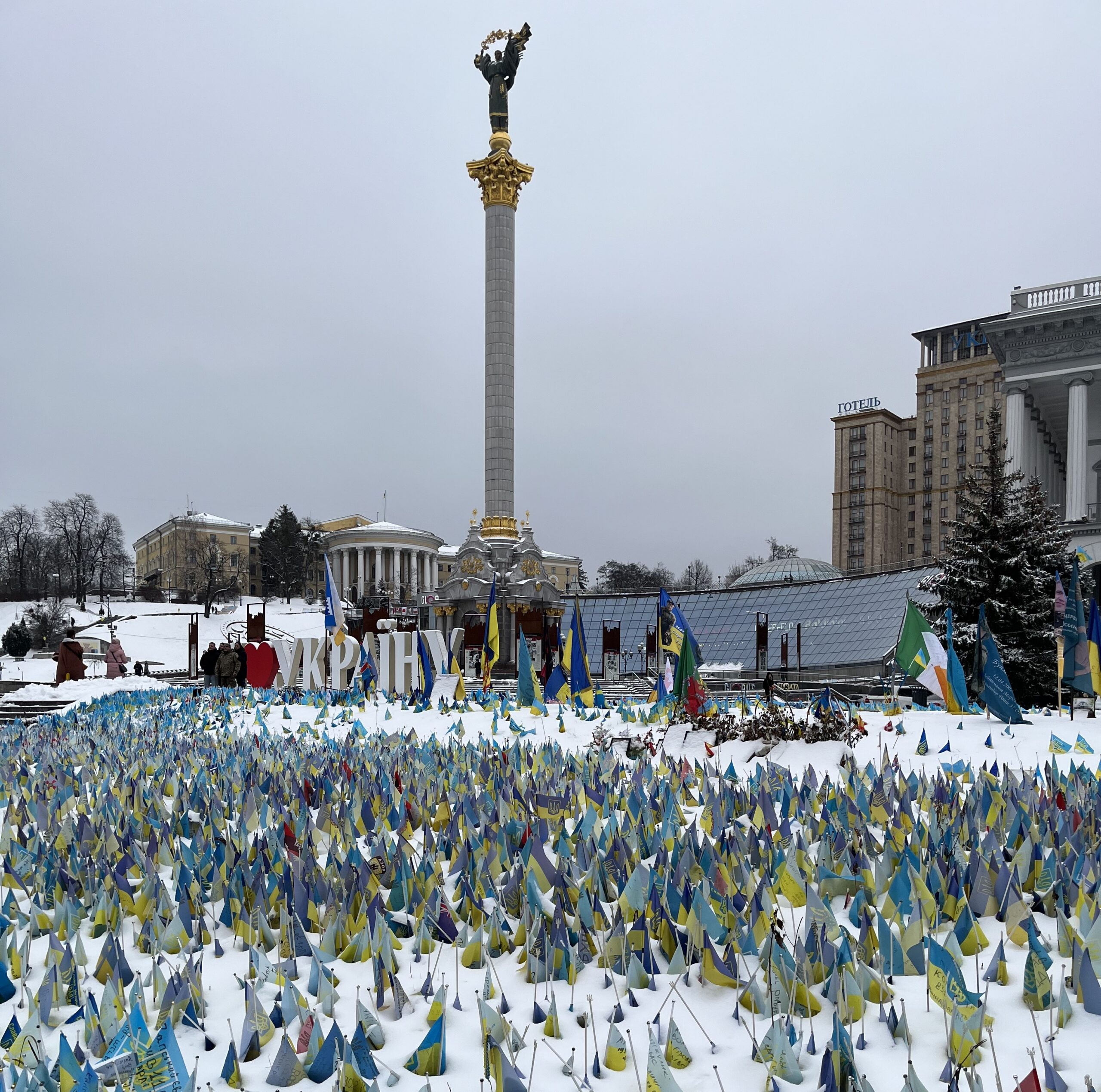
In recent months, there have been DJs and dancing on a frozen river to keep bodies and spirits warm after relentless Russian strikes on Ukraine’s energy grid. This is just one example to illustrate that the resilience I witnessed is still very much in evidence, and it’s especially remarkable given Ukrainians have been living through a brutal winter. Strikes on cities and critical civilian infrastructure have left millions without electricity and heating for months, even as temperatures have reached minus four degrees. The last year was also the deadliest for civilians in Ukraine since 2022 – with more than 2,500 civilians killed.
The last year was the deadliest for civilians in Ukraine since 2022 – with more than 2,500 civilians killed.
Q: Much of your work focuses on U.S. funding for programs that have been a lifeline for Ukrainians – many of which faced cuts over the past year. How has the shifting funding landscape in Washington affected conditions in the country?
The cuts have impacted the response on the ground and more importantly, the lives of so many.
As it relates to the energy grid, hundreds of millions of dollars in U.S. energy assistance previously pledged to the country remain unreleased. The funds were originally slated to be distributed by the U.S. Agency for International Development (USAID) to help Ukraine import liquefied natural gas and rebuild energy infrastructure damaged by Russian strikes. For the World Food Programme (WFP) and other agencies, they have been forced to cut food rations due to funding constraints and increased security risks near the frontline. In fact, in the past year, WFP has had to cease assistance to more than one million people.
Funding cuts have had a particularly devastating impact on girls and women. Due to cuts in 2025 and 2026, women-led organizations in Ukraine are projected to lose at least $53 million. As a result, women’s rights and women-led organizations stated they will be forced to stop life-saving services to at least 63,000 women and girls in need this year. Those hit hardest are those already most at risk: women and girls in frontline and rural areas, older women, women-headed households and women and girls with disabilities.
Hundreds of millions of dollars in U.S. energy assistance previously pledged for the country remain unreleased… WFP has had to cease assistance to more than 1 million people… Women-led organizations in Ukraine are projected to lose at least $53 million.
It must be noted, though, that thanks to partners including the European Union, WFP continues to support more than 600,000 Ukrainians in frontline regions every month with food and cash assistance. UN agencies like UNFPA are targeting almost one million women, girls and young people in Ukraine and neighboring refugee-hosting countries with life-saving sexual and reproductive health and gender-based violence services, in part by reinforcing national health systems and deploying mobile clinics.
Q: Russia has repeatedly targeted Ukraine’s energy infrastructure. What role is the UN playing to reduce the risks?
When I last visited in October 2024, I visited the second largest heating and power plant in Kharkiv. It had been hit twice by Russian missiles. On the day I visited, the plant had just been made operational again. Since that time, the UN – through its agencies – has mobilized emergency assistance to stabilize essential services.
This report provides a good summary, but in short:
- UNICEF is maintaining access to heating and safe drinking water, as both systems are often the first to shut down when electricity fails. By providing generators and backup equipment, the organization helps prevent shortages and reduce health risks.
- In parallel, WHO and UNICEF have supported hospitals, primary healthcare centers and schools with alternative power sources.
- UNHCR and partners have distributed winter insultation kits, heaters and cash support to help families buy firewood or other winter necessities and cover heating costs.
- In Kharkiv and other locales, UNDP and UNOPS have strengthened Ukraine’s energy resilience by delivering over $45 million in heating equipment, including solar panels and modular boiler houses to reduce reliance on centralized systems.
- Across the country, “invincibility points” – heated public spaces equipped with electricity, water and internet – have become critical during extended outages. UN agencies have supported those spaces with equipment and supplies so they can serve as safe havens when homes lose power.
Q: You’ve visited many of the world’s toughest conflict zones. What makes Ukraine distinct?
I’m always astounded by the resilience of individuals – from famine-stricken South Sudan to disaster-prone Nepal. In Ukraine, I’ve just had more opportunity to travel throughout the country and witness how they respond to atrocity and oppression. They have – in spades – the “courage to continue.”
Q: UN Human Rights official Danielle Bell recently warned of growing global attention fatigue. With so many crises competing for focus, what would you say to Americans about why sustained engagement still matters?
The reasons to support international engagement are legion and nicely encapsulated here by our friends at the U.S. Global Leadership Coalition.
To citizens and lawmakers, I say we “do well by doing good.” In Ukraine and elsewhere, international assistance to the UN helps create a more stable, secure world, reducing the risk of conflict and disease, which directly benefits the economic and security interests of our nation. It is a virtuous circle, which only amounts to 1% of our budget.
Alternatively, cutting aid today usually results in many more costs tomorrow. In places like Ukraine, it is significantly cheaper to provide housing repairs, generators and food aid now than it is to deal with a full-scale refugee crisis. Not to mention – as I noted when we last spoke – slashing assistance is the fastest way to break a nation’s spirit, leading to internal collapse. This failure, in turn, sends a signal to other global aggressors that our country lacks resolve, triggering further conflicts elsewhere. It is a vicious cycle we should avoid pursuing.
We “do well by doing good.” Assistance to the UN helps create a more stable, secure world, reducing the risk of conflict and disease, which directly benefits the economic and security interests of our nation.