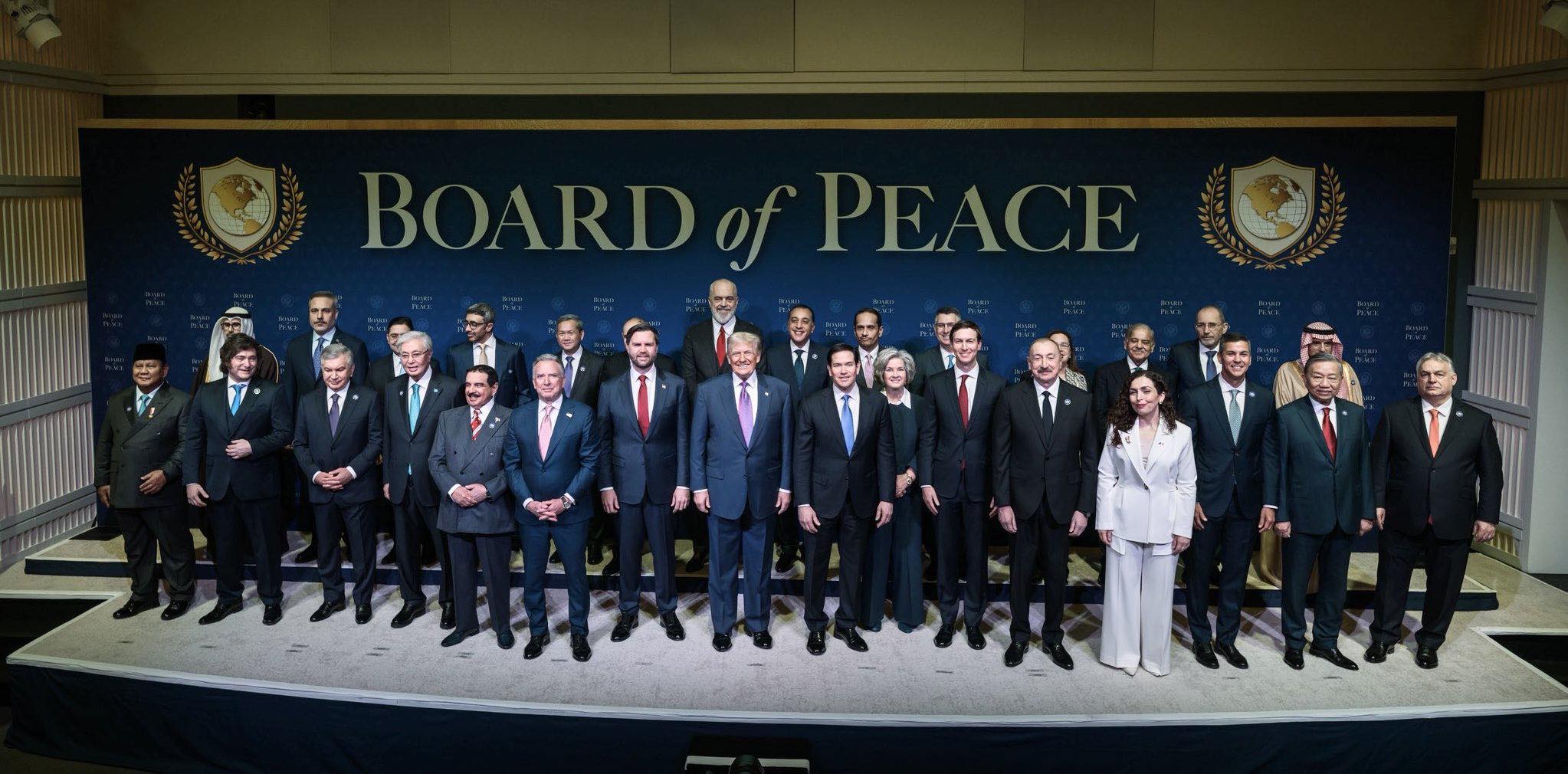
This piece was originally published on January 30, 2026, and is being updated regularly. The inaugural meeting of the Board of Peace was held at the Donald Trump Institute of Peace on February 19, 2026. The meeting can be viewed in its entirety.
A new international body known as the Board of Peace was formally launched in January, following a November vote by the UN Security Council through Resolution 2803 that welcomed a U.S.-brokered, 20-point framework to end the war in Gaza. The initiative gained decisive momentum on January 22, when President Trump signed the Board’s charter at the 57th World Economic Forum in Davos.
On February 19, President Trump convened the first meeting of the new Board in Washington, DC, announcing billions in pledges from select member countries to rebuild Gaza, while offering few details on how this will be achieved in practice. In addition, Secretary of State Marco Rubio suggested that the Board’s scope may expand, saying, “We hope that this can serve as a model for other complex and difficult situations, so they can be solved in the same way.”
Supporters of the Board describe it as a nimble alternative to collective action by the Security Council to facilitate reconstruction planning in Gaza. Skeptics, including close U.S. allies such as France and the United Kingdom, have raised concerns that the initiative could sidestep the existing multilateral system or be used to channel funding away from broadly supported UN organizations. For example, a spokesperson for France’s foreign ministry recently highlighted the “ambiguity” of the board’s scope, stating that it must “refocus on the situation in Gaza.”
As of now, there’s still much we do not know, and we will continue to fine-tune our analysis in the weeks and months ahead. But for now, let’s look beyond the headlines to examine the Board of Peace on its own legal and institutional terms.
What the Board of Peace Is
At its core, the Board is a selective coalition of willing states organized outside the UN system. While its establishment was endorsed by the UN Security Council -specifically as a “transitional administration” in Gaza for the purpose of coordinating reconstruction efforts – that endorsement does not extend to any operational plans or its governance.
Unlike the United Nations, it is not a universal body and does not rely on broad multilateral consensus to act. Instead, it is structured as a stand-alone organization designed to move quickly among a limited group of aligned participants.
The Board’s governance model is explicitly centralized. Its charter establishes a chairman-centered structure under which President Trump, as Chairman, holds sweeping authority to invite or exclude members, break ties and approve or veto all Board resolutions.
Membership is invitation-only, with three-year terms that are renewable at the Chairman’s discretion rather than through collective decision-making.
Financially, the Board relies entirely on voluntary contributions. Long-term participation currently requires a reported $1 billion financial commitment, reinforcing its character as a high-threshold, opt-in forum rather than an inclusive institution.
While its immediate focus is intended to be the Gaza ceasefire framework, the charter grants the Board authority to expand to address conflicts in which it determines that stability or lawful governance is at risk. Of note, the current charter for the board makes no direct mention of Gaza.
Is the Board Replacing the UN or the Security Council?
This is a key question, which is still not answerable, in part because of the conflicting signals sent from the Administration. During the inaugural meeting of the Board, President Trump suggested it may one day supersede the UN, saying, in the future, “the Board of Peace is going to almost be looking over the United Nations and making sure it runs properly.” Nevertheless, the President also spoke positively about the global body, noting, “We’re going to make sure the United Nations is viable,” and promising to “help them, moneywise.”
More broadly, it is important to know that, although the Board of Peace is often discussed in the same breath as the Security Council, the two bodies operate on fundamentally different legal foundations.
The Security Council derives its authority from the UN Charter, a treaty ratified by UN Member States that explicitly assigns it primary responsibility for the maintenance of international peace and security. That mandate was conferred collectively by the international community and cannot be replicated by a separate organization asserting a similar mission.
Equally important is the question of binding authority. Under Article 25 of the UN Charter, UN Member States are obligated to carry out decisions of the Security Council. The Board of Peace has no comparable mechanism. Its decisions apply only to those states that choose to participate and carry no legal force for non-members.
The distinction becomes most consequential when it comes to enforcement. Only the Security Council possesses unique Chapter VII powers, including the authority to impose sanctions and authorize the use of force in ways that are recognized across jurisdictions.
The Board of Peace, by contrast, can coordinate political positions and financial support but cannot create enforcement regimes that bind the international system as a whole.
The Takeaway: Coordination Versus Authority
Read on its own terms, the Board of Peace is best understood as a coordination platform – a mechanism for like-minded states to act quickly around a specific political objective, initially Gaza, without the procedural constraints of universal multilateralism. In that sense, it could theoretically offer speed and flexibility where the UN system is deliberately cautious.
What it cannot offer is legal legitimacy on a global scale. The ability to authorize peacekeeping missions, impose sanctions that endure across changing governments and anchor ceasefires in recognized international law remains exclusive to the UN Security Council. These are not abstract distinctions. They are the reason UN-backed decisions carry weight beyond the moment and beyond the membership of any single coalition.
Bottom line? If the Board of Peace succeeds in its mission, it may ultimately complement multilateralism by functioning as a rapid-response forum. As it currently stands, however, it cannot replace the foundations of a system grounded in treaty law and universal membership.
Official White House Photo by Daniel Torok
Current Membership
Chairman
President Donald J. Trump
Board of Peace Members
60 invited, seats are represented by heads of state
- Argentina
- Armenia
- Azerbaijan
- Bahrain
- Bulgaria
- El Salvador
- Hungary
- Indonesia
- Jordan
- Kazakhstan
- Kosovo
- Mongolia
- Morocco
- Pakistan
- Paraguay
- Qatar
- Saudi Arabia
- Turkey
- United Arab Emirates
- United States
- Uzbekistan
Executive Board
Focused on diplomacy and investment
- Nickolay Mladenov
- Marco Rubio
- Steve Witkoff
- Jared Kushner
- Tony Blair
- Marc Rowan
- Ajay Banga
- Robert Gabriel, Jr.
Gaza Executive Board
Directs the National Committee for the Administration of Gaza
- Steve Witkoff
- Jared Kushner
- Hakan Fidan
- Ali al-Thawadi
- Hassan Rashad
- Tony Blair
- Marc Rowan
- Reem Al-Hashimy
- Nickolay Mladenov
- Yakir Gabay
- Sigrid Kaag