On Friday, April 3, the Trump Administration released its proposed budget for FY2027, which begins on October 1, 2026.
While presidential budgets are ultimately proposals — as Congress retains authority over appropriations — the recommendations continue to signal significant changes in the approach to U.S. diplomacy, development and multilateral engagement.
A Smaller Diplomatic Footprint
For decades, U.S. engagement in international institutions has been supported by a combination of assessed contributions, peacekeeping support and voluntary funding for development and humanitarian programs. The FY2027 request reflects a more targeted approach.
The topline request for the State Department — $33.6 billion — is a roughly 30 percent reduction from current levels.
Narrowing the Scope of Multilateralism
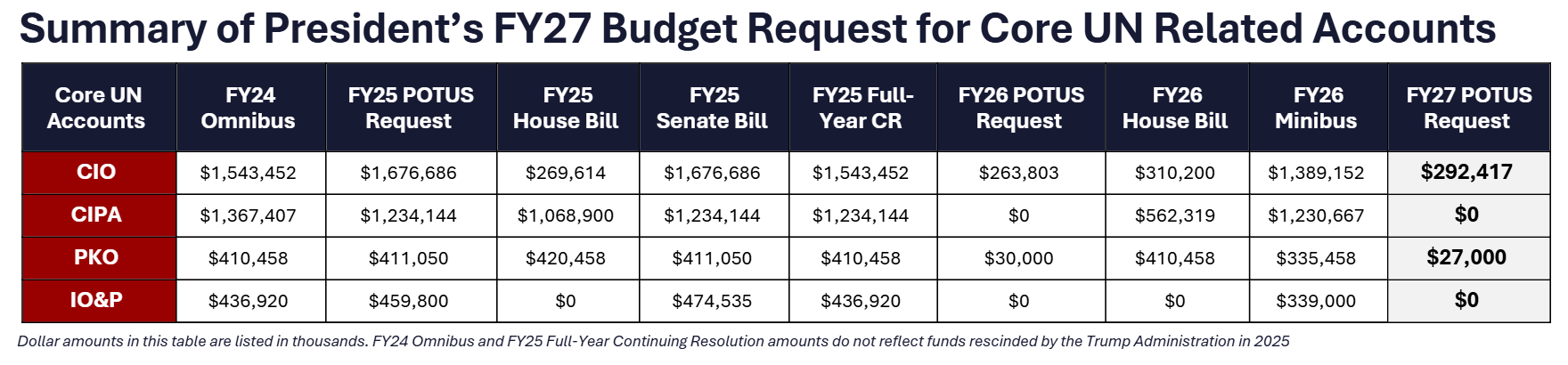
The Contributions to International Organizations (CIO) account is reduced by nearly 80 percent, to $292 million. Funding for the UN regular budget and most specialized agencies is eliminated entirely.
In its place, the Administration proposes funding just seven organizations it says “directly advance U.S. national security, economic interests and global stability… and the safety of Americans or the promotion of American interests.” These organizations include: the International Atomic Energy Agency (IAEA), NATO, the Organization for the Prohibition of Chemical Weapons, the International Civil Aviation Organization (ICAO), the International Telecommunication Union (ITU) and the International Maritime Organization (IMO).
Organizations slated to receive no assessed funding under the proposal are the International Labor Organization (ILO), Food and Agriculture Organization (FAO), UNESCO, the World Health Organization (WHO), the Universal Postal Union (UPU), the World Intellectual Property Organization (WIPO) and the World Meteorological Organization (WMO).
Peacekeeping: From Predictable to Case-by-Case Funding
The budget eliminates funding for Contributions for International Peacekeeping Activities (CIPA), despite Congress appropriating around $1.2 billion for the account in FY2026.
Rebranded as “National Security Engagement Assistance,” the former Peacekeeping Operations (PKO) account is reduced from just over $335 million to $27 million — a 92 percent cut. Most of what remains is directed to the Multinational Force and Observers (MFO) in Sinai, which monitors the 1979 Egypt-Israel Peace Treaty.
Support for other peacekeeping missions is not eliminated outright, but made discretionary and shifted to the America First Opportunity Fund (more below) and contingent on a determination that such efforts serve national interests. At the same time, the proposal leaves room for targeted investments, including a referenced $150 million for Haiti-related efforts, potentially covering the new Gang Suppression Force UN Support Office.
Eliminating Critical Voluntary Funding for Development
The budget again proposes eliminating the International Organizations and Programs (IO&P) account, which funds voluntary U.S. contributions to UN agencies like UNICEF, UNDP and UN Women, as well as programs focused on development, humanitarian aid and human rights.
Those funds support much of the day-to-day work of the international system, but the proposal does not offer a direct replacement — reflecting a broader push to consolidate and more tightly control how these contributions are made.
A similar request was put forward last year, with Congress ultimately restoring much of the funding.
Global Health: Cuts with Targeted Continuity
The Administration requests $5.1 billion for State Department global health programs — more than 45 percent below FY2026 levels — alongside $664 million for global health activities through the Centers for Disease Control.
The proposal also introduces an America First Global Health Strategy, consolidating programs and emphasizing “essential immunizations” and “life-saving vaccinations.”
It maintains support for malaria, tuberculosis and polio programs, contributions to the Global Fund and renewed attention to maternal and child health. No funding is requested for Gavi and funding is, in general, made more conditional and centralized.
Humanitarian Assistance, Reoriented
The proposal reshapes humanitarian assistance, reducing overall funding while more explicitly aligning it with strategic priorities of the Administration.
The Administration requests $4 billion for International Humanitarian Assistance (IHA), down from $5.4 billion in FY2026, and $500 million for the Emergency Refugee and Migration Assistance (ERMA) account, an increase from $100 million enacted. Together, these shifts reflect both a reduction in topline funding and a recalibration of how resources are directed.
Assistance would be prioritized for crises with a “clear, direct connection to U.S. national interests,” particularly those tied to migration and regional stability. While traditional humanitarian programs remain eligible, the proposal places greater emphasis on efforts to reduce irregular migration, support voluntary returns and incentivize Safe Third Country Agreements, framing humanitarian aid more directly within a broader migration and foreign policy context.
Of note, IHA “may also provide potential contributions to the Board of Peace, including to support Gaza relief.”
The America First Opportunity Fund: A Centralized Funding Mechanism
The proposed $5 billion America First Opportunity Fund (A1OF) sits at the center of the request, reshaping how the U.S. could finance its engagement with international institutions.
The Fund is designed to replace multiple accounts with a single, flexible pool that the Administration could draw from to “pay any assessments for the UN regular budget, peacekeeping or other international organizations” it deemed in the national interest. This includes funding the new Board of Peace.
Importantly, the Fund is not limited to internationally-focused organizations and may also support a broader range of programs and activities.
Congress Holds the Final Say
As with any presidential budget, Congress will ultimately determine funding levels through the appropriations process. Under the U.S. Constitution, it holds the power of the purse, setting funding levels and policy direction through annual appropriations bills passed by both chambers and signed into law.
In previous cycles — including last fiscal year — strong bipartisan majorities of lawmakers rejected a number of proposed reductions, restoring funding for UN peacekeeping, development programs and other international priorities. A similar dynamic is likely to emerge again this year.
Even so, the budget serves as a clear statement of the Administration’s priorities, framing the debate Congress will now take up — and signaling a broader reconsideration of not just how much the United States spends abroad, but how it approaches its role in global leadership.