Note: Throughout our resources, the Better World Campaign often refers to “SFOPS,” shorthand for the State, Foreign Operations, and Related Programs subcommittee. At the start of the 119th Congress, the House Appropriations Committee renamed this panel the National Security, Department of State, and Related Programs (NSRP) subcommittee. The Senate Appropriations Committee has retained the SFOPS title.
In early January, lawmakers released the FY26 National Security, Department of State, and Related Programs (NSRP) bill – the spending package that shapes how the United States invests in diplomacy, foreign assistance and international organizations.
On January 14, the bill passed the House by a strong bipartisan vote of 341–79 and is now headed to the Senate for consideration.
As the Better World Campaign noted at the bill’s release, the outlook for America’s global engagement was encouraging. Bipartisan, bicameral support for multilateral foreign assistance was on display in the final package.
While overall funding is lower than FY24 levels, Congress took decisive steps to restore U.S. dues to the United Nations and funding for UN peacekeeping operations – reinforcing America’s commitment to leadership on the world stage.
Because these “minibus” appropriations packages can be hard to decode, here’s a plain-English breakdown of what made the cut.
The 10,000 Foot View
Overall, the bill provides $50 billion for U.S. international engagement, including $9.4 billion for global health. It does come in at about 16% less than FY’25 levels, with voluntary funding for UN agencies slimmer and humanitarian assistance down compared to recent years. However, the funding outlined in the bill preserves core U.S. treaty obligations to the UN system, especially the regular budget and peacekeeping. Those payments keep the lights on at UN headquarters and support peace operations that help stabilize conflict zones.
Specifically, here’s where the UN-related money goes:
- $1.39 billion for Contributions to International Organizations (CIO)
- $1.23 billion for Contributions for International Peacekeeping Activities (CIPA)
- $335.4 million for Peacekeeping Operations (PKO)
- $339 million for International Organizations and Programs (IO&P)
Together, these accounts support U.S. participation in institutions that shape diplomacy, humanitarian response and global security.
U.S. Dues Are Back
The Contributions to International Organizations (CIO) account is how the U.S. pays its assessed dues to the UN regular budget, UN specialized agencies and dozens of other global bodies, including NATO, the Organization of American States (OAS) and the Organization for the Prohibition of Chemical Weapons (OPCW).
This year’s $1.389 billion is about 10 percent lower than recent levels but sufficient to meet most U.S. treaty obligations. The main exceptions are agencies the Administration has already withdrawn from, such as UNESCO and WHO.
One important new twist – the bill allows the Secretary of State to shift up to $466.5 million from a “National Security Investment Programs” account into UN dues and peacekeeping if it helps advance reforms in the national interest.
Congress also dropped a proposal that would have defunded the entire UN Secretariat over conditions tied to the UN Relief and Works Agency for Palestine Refugees (UNRWA), the main aid agency in Gaza, the West Bank, Lebanon, Syria and Jordan that provides health and education services to roughly six million Palestine refugees. An existing U.S. funding ban on UNRWA remains in place through March 25, 2027.
To keep tabs on how the money is used, the Department of State must brief lawmakers within 30 days on spending plans, unpaid dues, the national security impact of nonpayment and any plans to withdraw from UN bodies. Many of these oversight steps align with the UN80 reform efforts already underway at the UN.
Of note, Congress does not publish a line-by-line breakdown of how much each organization receives.
Peacekeeping, Protected
Peacekeeping is where the U.S. helps fund missions that prevent conflicts from spiraling out of control.
For FY26, the Contributions for International Peacekeeping Activities (CIPA) account is funded at $1.23 billion – nearly the same as last year and enough to meet U.S. obligations under the legal 25 percent cap. Even better, $615 million of that funding can be used over two years, giving Congress more flexibility to spend the money and not have it rescinded.
Bottom line – U.S. influence in peacekeeping is protected and the risk of losing voting rights due to unpaid dues can be avoided.
Stability, Region by Region
Related to peacekeeping, the Peacekeeping Operations (PKO) account supports regional security missions and logistical assistance in places essential to American security.
For FY26, it receives $335.4 million. That’s less than the FY24 and FY25 enacted totals but significantly more than the President’s FY26 request.
One notable shift is that Congress did not lock this money to Somalia as it has in the past. Instead, it gave the Administration flexibility to use the funds for the UN-authorized Gang Suppression Force in Haiti, as well
Same bucket. More options.
Voluntary, But Vital
The International Organizations and Programs (IO&P) account is how the U.S. supports agencies like UNICEF, the UN Development Programme (UNDP), the Office of the High Commissioner for Human Rights (OHCHR), the UN Environment Programme (UNEP) and the Office for the Coordination of Humanitarian Affairs (OCHA), with whom the U.S. has just partnered for major humanitarian aid reform.
Both the House and the Administration tried to eliminate this account entirely. Congress said no, restoring it at $339 million. That’s still about 22 percent lower than recent levels but it keeps the U.S. engaged across key UN agencies.
Lawmakers directed the Department of State to fund agencies “consistent with prior years” and made one point clear – UNICEF should continue receiving support at past levels.
The bill also sets aside $32.5 million for the UN Population Fund (UNFPA), with a legal escape clause, and requires the Department of State to show Congress how it plans to spend the money.
The goal is transparency without micromanagement.
Where Cuts Hit Hardest
The Administration reshaped humanitarian funding into a new International Humanitarian Assistance account and reduced overall funding. Congress agreed. For FY26:
- $5.4 billion for International Humanitarian Assistance
- $100 million for the Emergency Refugee and Migration Assistance fund
That’s roughly $3 billion less than what the U.S. provided for key humanitarian response accounts in recent years. And in a world beset by crises, that matters.
Some Strings Attached
The bill also comes with a long list of conditions on UN funding:
- Ties some bilateral aid decisions to how countries vote at the UN, including support for Taiwan’s observer status
- Withholds 10 percent of UN funding until certain requirements around transparency, accountability, and other standards are met
- Prohibits funding for the UN Human Rights Council unless certain conditions are met
- Pushes the UN to stop buying from Russian vendors
- Requires justification for funding organizations that deny U.S. auditors access
Many of these provisions echo past Congresses but continue to shape how and when UN funding is released.
An Arrears Reality Check
There’s one important reality to keep in mind: the U.S. still has major outstanding financial obligations to the UN.
While many other Member States have already paid their 2025 dues, the U.S. has not yet provided any funding to cover its share of the UN regular budget and has paid only about 30 percent of its peacekeeping assessments.
Those arrears affect UN operations and, over time, significantly limit U.S. influence inside the system. Passage of the FY26 bill would be a meaningful step toward addressing those shortfalls, upholding U.S. treaty commitments and advancing U.S. interests.
Key Takeaways
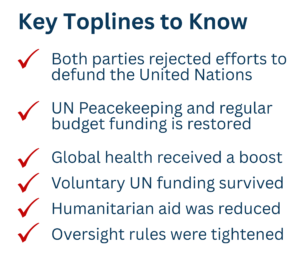
In a fraught political environment, the bill is good news. The UN was not defunded. Peacekeeping was backed. Core U.S. commitments remained and Congress, in a resoundingly bipartisan fashion, voted for paying our fair share.
At the same time, humanitarian aid is leaner, voluntary funding is tighter and oversight rules are stronger than ever.
So yes – there’s work to do. More advocacy. More education. More reform.
But the U.S. is showing up. And in a world where global problems don’t respect borders, that still matters. A lot.
In a fraught political environment, the bill is good news. The UN was not defunded. Peacekeeping was backed. Core U.S. commitments remained and Congress, in a resoundingly bipartisan fashion, voted for paying our fair share.