While 2025 revealed significant challenges in the U.S.-UN relationship, it also underscored just how central the UN remains to advancing U.S. foreign policy priorities.
Time and again, the United States turned to the Security Council – successfully working through the body to press for an international force to confront gang violence in Haiti, renew sanctions on Iran and advance an historic resolution aimed at ending the war in Gaza.
Each initiative now faces its own journey beyond the Council. But how they made it through the chamber offers insight into diplomacy at work – of negotiation, process and compromise.
This is how that process works – from idea to adoption.
1. The Starting Line
It all begins when one or more Council members “take up the pen.” In UN parlance, the “penholder” is the delegation responsible for drafting the text. It’s typically a Member State aligned with the resolution’s core objective, though not necessarily the most vocal or visible player on the issue.
The initial work usually starts behind closed doors at a UN mission in New York. There, issue experts work the phones – consulting regional groups, affected countries, key stakeholders and fellow Council delegations.
On high-stakes crises, the first draft can take weeks to shape and extend well beyond the Council’s 15 seats. The goal is simple but demanding: line up enough support – ideally unanimous, at minimum a majority – to act within the Council’s mandate. Early outreach matters, as boad buy-in at the start can prevent major political headaches later.
2. The “Zero Draft”
Next comes what diplomats call a “zero draft.” It’s a working text circulated purely for comment. Shared informally by email or message, it’s reviewed through a mix of written feedback, brief check-ins, hallway conversations and even WhatsApp or Signal messages. Delegations strike language, add caveats and suggest alternatives. The penholder’s team then consolidates those inputs, moving the text closer to a viable draft.
3. Negotiation
Once a draft exists, debate begins – and this is where things can get dicey. That’s because language is everything. A word like “ceasefire,” for example, carries very different weight than “truce.” Sorting out those nuances is the work of careful negotiation.
That negotiation usually happens off the record and off the floor. Formal discussions in the Council’s Consultations Room – just steps from the Chamber – are rare. Often, feedback comes from officials back in national capitals rather than from New York itself. This phase isn’t about speeches. It’s about finding language enough governments can live with, even if no one gets everything they want. (And no one ever gets everything they want.)
4. Going “in Blue”
After several rounds of negotiation, the penholder circulates a final draft. Depending on the stakes, it may also be shared with the wider UN membership to line up co-sponsors.
At that point, the text is assigned a document number and issued “in blue.” Once delivered on paper in blue ink, it now arrives in representatives’ email inboxes – still in blue font. The color is a historical quirk dating back to the 1970s when Security Council photocopiers used blue ink.
When a draft goes in blue, the message is clear: the Council is ready to act. A vote usually follows within 24 hours.
5. The Vote
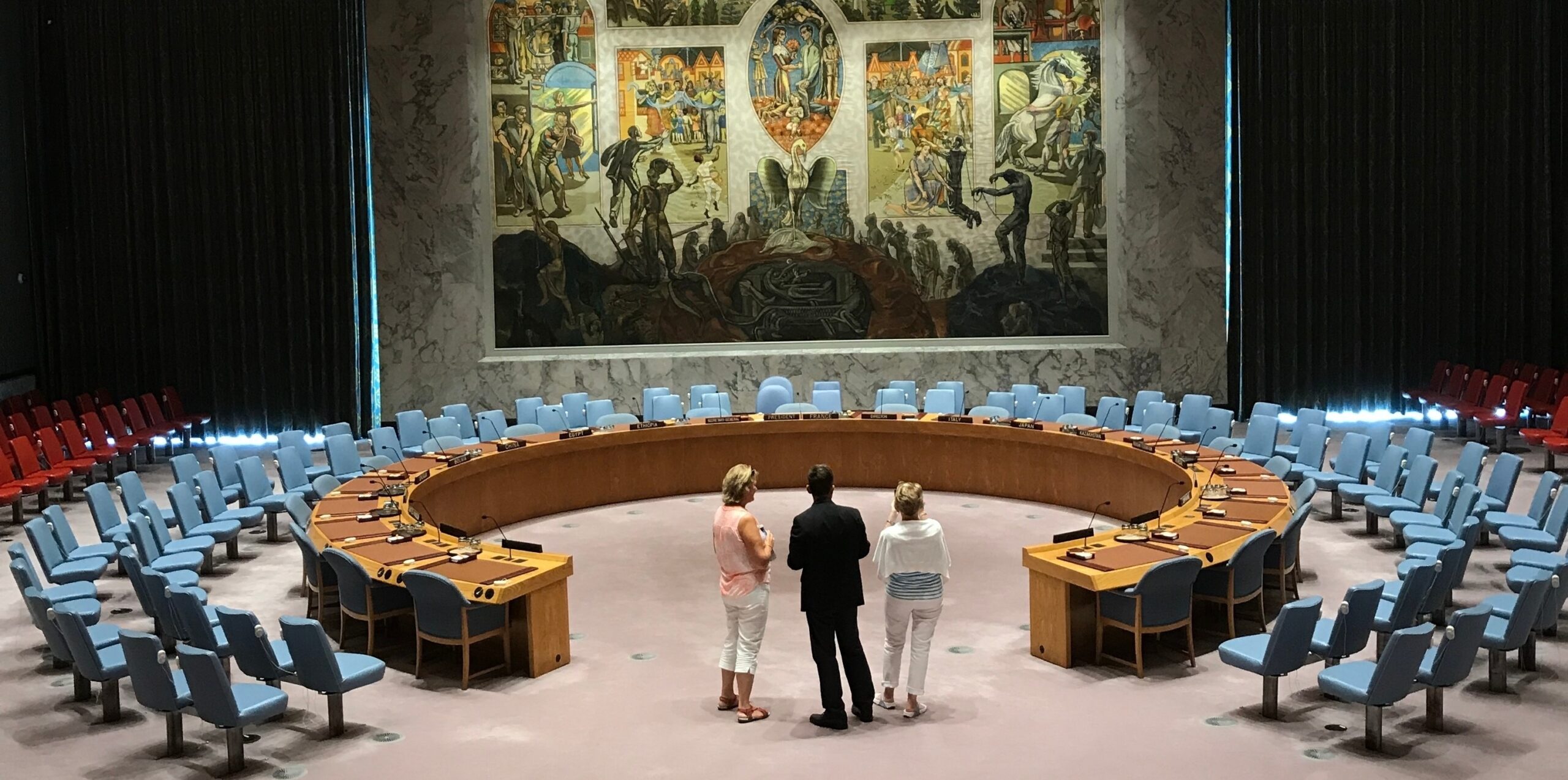
The vote takes place at a formal, open meeting around the Security Council’s iconic horseshoe table. The Council president – an office that rotates monthly – gavels the session to order. Delegations make final statements outlining their support or reservations. Amendments may also be introduced. Then the president calls for action. A show of hands determines the outcome.
For a resolution to be adopted, at least nine members must vote in favor – and none of the five permanent members (the U.S., China, France, Russia or the United Kingdom) may cast a veto. Permanent members can, however, abstain, allowing a resolution to pass without their explicit support.
Watch proceedings of Security Council meetings live on UN TV.
6. From Blue to Black
The final step is administrative but profoundly consequential. Once adopted, a resolution is translated into the UN’s six official languages and published in black, entering the Security Council’s permanent record. Every draft – passed or not – is numbered and archived.
It’s worth noting that those records will soon become much easier to search, offering the public greater insight into how decisions evolve behind closed doors.
Find all Security Council resolutions in their archive.
From conception to adoption, what emerges through the process is diplomacy not as spectacle, but as real craft – built painstakingly and through compromise. It’s rarely tidy, often frustrating and – as 2025 demonstrated – still one of the few ways the international community moves from crisis to collective action.