

The first Nor’easter of the season knocked out power shortly after my interview with Ko Barrett began. On a glitching screen beside a New Hampshire fireplace, I pleaded with my phone for a hotspot while Barrett – the deputy secretary-general of the United Nations’ World Meteorological Organization and the first American in its leadership – smiled. “I miss fireplaces,” she said disarmingly. “At home on my farm in North Carolina, we heat with a woodstove.”
I liked her instantly.

There I was, half-frozen and half-offline, while the woman responsible for safeguarding the planet’s weather data was reassuring me over a video call. It felt oddly appropriate.
Barrett’s résumé stretches across the modern climate world: two decades at the National Oceanic and Atmospheric Administration (NOAA), years representing the U.S. in international climate negotiations, vice-chair of the Intergovernmental Panel on Climate Change (IPCC) – the body whose work earned her and her colleagues a Nobel Peace Prize – and a fierce champion for women as she shattered glass ceilings on the climb. Now she oversees the global architecture of weather prediction – a system billions rely on every day. Barrett is a powerhouse.
So is that system – the World Meteorological Organization.
Most Americans have never heard of it. Yet WMO data helps determine if planes get off the ground and whether you reach for a raincoat on a Tuesday morning. “Reliable forecasts don’t happen by accident,” Barrett told me. “No country can know the world’s weather on their own.”
That’s where the value of WMO is unmatched – and U.S. collaboration makes all the difference.
“Reliable forecasts don’t happen by accident… No country can know the world’s weather on their own.”
From the World to Mount Washington
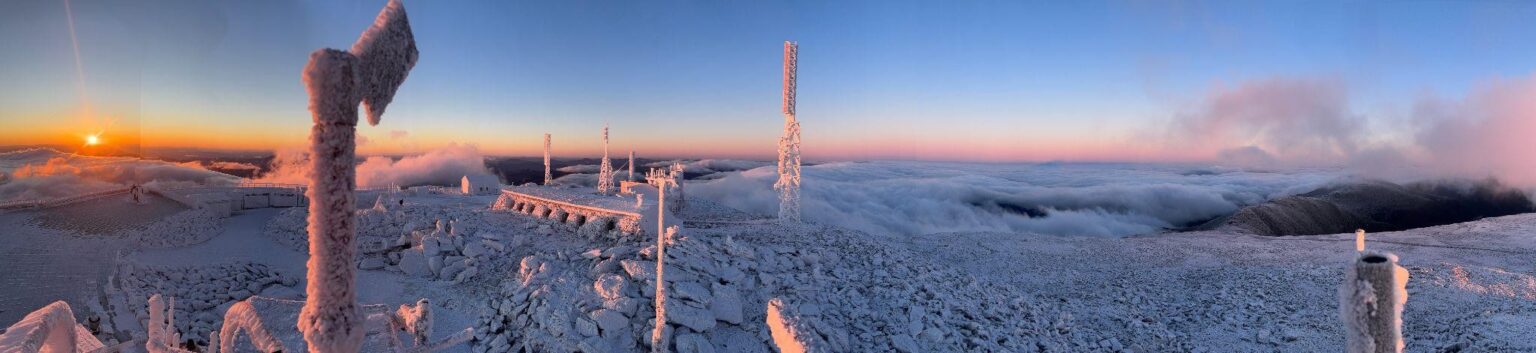
To understand just how intertwined America’s weather system is with the rest of the world, the highest peak in New England offers a vivid illustration. Atop the Mount Washington Observatory – where the weather is so feral that it once clocked the world’s fastest wind speed, a brutal 231 mph – a small team of scientists produces the forecast that generations of locals, hikers and search-and-rescue crews have relied on.
“When anyone heads into the White Mountains, they start with our data,” Drew Bush, PhD, the Observatory’s executive director, said. “The Forest Service, Fish and Game, the Appalachian Mountain Club – they all depend on it.”
“On the worst days,” he added, “they’re calling us by the minute asking for specifics.”
Their data is both hyperlocal and sweeping. It shapes maritime forecasts, guides aviation experts and hosted research to improve how the U.S military defrosts their aircraft. And when conditions allow, they even turn to studying cosmic rays from space.
From their supercomputers and laboratories, the Observatory’s readings go into NOAA’s systems, then on to WMO’s global exchange. One gust at the peak becomes part of the world’s hurricane models, flood maps and aviation alerts. “What we do locally matters to people nationally and internationally,” Bush said. “It’s all connected.”
“What we do locally matters to people nationally and internationally… It’s all connected.”
That’s the point. In fact, part of billions of datapoints. That happens in the Granite State – or any state – really does matter to the rest of the planet.
The entire network – stretching from the American northeast to the rest of the world – exists because nations decided, improbably, that it should.
The Origins of the Improbable
This improbable idea traces back to 1853, when naval officers from ten nations met to compare ship logs. The U.S. delegate marveled that so many navies would gather “not at the cannon’s mouth,” but for the “noble purpose of serving humanity.”
In 1873, meteorologists standardized observations across borders, laying the groundwork for what would become WMO. Even at the height of the Cold War, American and Soviet scientists worked through WMO to build the World Weather Watch, the backbone of modern forecasting. When political leaders weren’t speaking, scientists were.
When political leaders weren’t speaking, scientists were.
Today, WMO oversees the sprawling infrastructure they built. It founded the IPCC. It maintains the world’s official temperature, rainfall, wind and lightning records. It names the hurricanes. (And fun fact: an Australian meteorologist once named storms after politicians he disliked.) It curates the International Cloud Atlas, which may seem quaint until you remember those nimbi can make or break a harvest.
But the machinery behind all this is straining. WMO’s budget has been cut by a third. Weather stations in poorer countries struggle with outdated equipment. Sensors are destroyed in conflict zones. And the extremes Americans now endure – Arizona heat, Texas floods, Florida hurricanes – demand faster, sharper warnings.
“People increasingly experience climate through its extremes,” Barrett told me. “They need early warning. That starts with data.”
“People increasingly experience climate through its extremes… They need early warning. That starts with data.”
Bush put it in even starker terms: “The atmosphere doesn’t care about borders. If one piece of the system weakens, forecasts everywhere get worse.”
The Human Side of Leadership
For all her technical authority, Barrett carries the welcome ease of someone shaped by her native Appalachia. She describes spring as “the smell of a forest floor.” She once briefed world leaders with her dog, Finn, curled beside her. Her mix of precision and humility reminded me that the global weather system rests on very human shoulders – people with woodstoves and outages, farms and families, keeping a planet’s worth of storms at bay.
NASA climatologist Marshall Shepherd said it best: “The weather’s happening all around us… The systems that help us understand it are the scaffolding of modern life – invisible, until they break.”
It’s a perfect metaphor for the UN – and for WMO. Mostly unseen. Absolutely vital. Until it’s gone.
Here in New Hampshire, tending my own stove, I take comfort knowing Barrett is in Geneva tending the global machinery – and that Bush is on the summit sending down the next warning before the wind picks up. Between them, and thousands more, they’ll make sure tomorrow’s forecast arrives right on time. A small miracle of global cooperation to help us navigate the wintry roads ahead.
“The weather’s happening all around us… The systems that help us understand it are the scaffolding of modern life – invisible, until they break.”