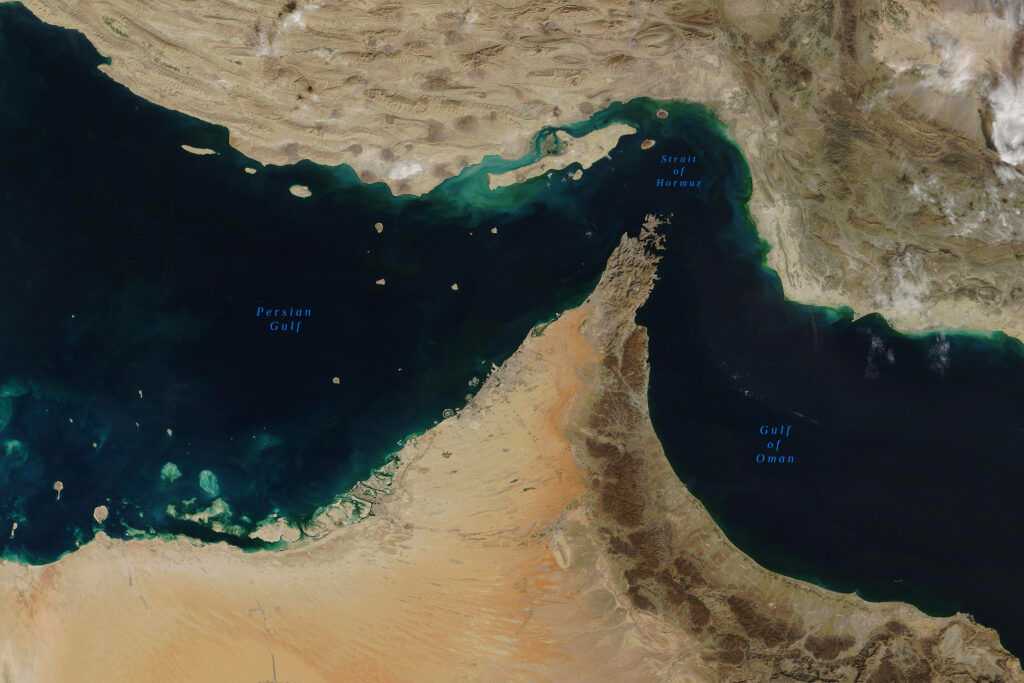
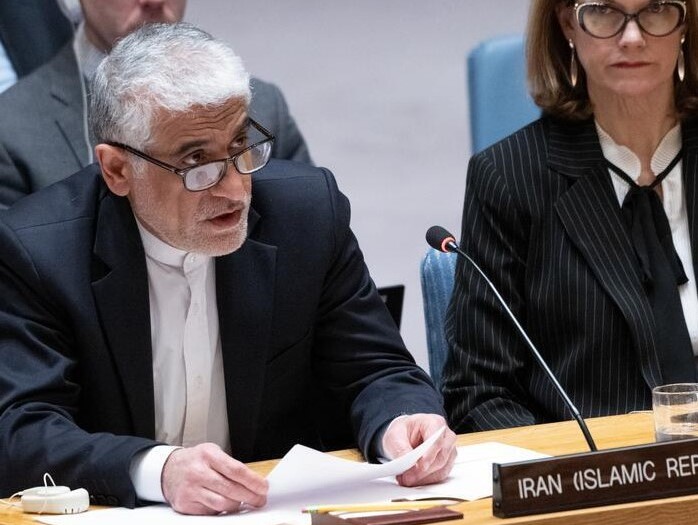
When the UN Security Council voted Wednesday, March 11, condemning Iran’s missile and drone strikes across the Gulf, the resolution hinged on Chapter VII, Article 51 of the UN Charter.
The text of Resolution 2817 condemns Iran’s “egregious attacks” on Bahrain, Kuwait, Oman, Qatar, Saudi Arabia, the United Arab Emirates and Jordan, and reaffirms those states’ “inherent right of individual or collective self-defense.”
As the U.S.-Israel war against Iran spreads across the Gulf, Article 51 is becoming the central legal framework through which governments are interpreting the conflict.
It’s also being tested and invoked more frequently than at any time in decades.
Restraining Aggression
Article 2(4) of the UN Charter requires states to refrain from “the threat or use of force against the territorial integrity or political independence of any state” with two explicit exceptions.
The first is when Member States of the Security Council authorize force under Chapter VII.
The second is when one or more Member States claim self-defense under Article 51, which states:
“Nothing in the present Charter shall impair the inherent right of individual or collective self-defence if an armed attack occurs against a Member of the United Nations…”
An Increasingly Common Claim
In recent years, governments have invoked Article 51 far more frequently than in the past.
In fact, in an official communication to the Security Council, Mexico’s diplomatic mission noted that the provision has been cited at least 78 times since 2021 – a sharp increase compared with earlier decades.
Several recent examples illustrate how broadly the doctrine is being used.
In June 2025, the U.S. launched strikes on Iranian nuclear facilities during Operation Midnight Hammer. In a formal Article 51 letter to the Security Council, Washington argued the attacks were “necessary and proportionate” measures to defend Israel and U.S. security after diplomatic efforts failed.
Days earlier, Israel carried out its own strikes inside Iran. A communiqué from the Israeli Foreign Minister described the operation as necessary to thwart “imminent Iranian attacks,” language understood as invoking anticipatory self-defense, though they did expressly mention Article 51.
In September, Israel also carried out a strike targeting Hamas leadership in Qatar, framing the action as part of its continuing self-defense following the October 7, 2023 attacks.
Even operations far from traditional battlefields have been justified in this way. A U.S. strike against a vessel allegedly involved in drug trafficking in the Caribbean was defended in a war powers report as self-defense against threats emanating from states “unable or unwilling” to address them.
Necessity and Proportionality
Two conditions must be met for a use of force to be permissible under Article 51:
Necessity — force must be required to repel or prevent an armed attack.
Proportionality — the response must be limited to what is necessary to address the threat.
These principles were reinforced by the International Court of Justice in cases such as Nicaragua v. United States and Oil Platforms (Iran v. United States). Together, they serve as the legal yardstick for determining whether military action qualifies as legitimate self-defense or unlawful aggression.
The Debate Over “Imminent” Attacks
Disagreements frequently arise over when the right of self-defense actually begins.
Many countries argue the Charter is clear – self-defense applies only after an armed attack has occurred.
That interpretation is widely supported by countries in the Global South and was reaffirmed at the 2024 summit of the Non-Aligned Movement. (Founded in 1961, NAM is a forum of 120 nations not formally aligned with or against any major global power).
The U.S. and several allies take a broader view, arguing that states can act when an attack is imminent – allowing military force to prevent a strike before it happens.
The “Unwilling or Unable” Doctrine
The most controversial extension of Article 51 involves attacks on non-state actors operating inside another country’s territory. Under this “unwilling or unable” doctrine, a state may use force in another country if that government cannot or will not prevent attacks originating there.
The U.S. invoked this reasoning during the international campaign against ISIS in Syria, beginning in 2014.
Many governments, however, reject the doctrine entirely.
At a UN debate on Article 51 convened by Mexico in 2021 some countries, including Australia, supported the doctrine broadly. Others proposed narrower conditions requiring evidence the host state was harboring or supporting the armed group. China and Mexico went further, arguing the doctrine has no basis in the Charter at all.
Reporting Requirements
States invoking self-defense are required to immediately report their actions to the Security Council.
These reports – usually letters to the Council president – are meant to allow other governments to evaluate claims of self-defense and determine whether the Council should intervene.
In practice, the system is inconsistent.
During the international campaign against ISIS, the U.S. submitted a detailed legal explanation invoking the “unwilling or unable” doctrine. Other participating countries such as the U.K. and France provided far less detail.
And then there are cases when states invoke self-defense without submitting reports at all.
Russia, for example, cited Article 51 when it launched its invasion of Ukraine in 2022, attaching a speech by President Vladimir Putin as justification. India described a cross-border operation in Pakistan as self-defense, but never formally notify the Council.
The Future of the Rule Against War
Against that backdrop, the Council’s latest resolution carries both legal and political weight.
By invoking Article 51, the Security Council signaled that Iranian strikes against Gulf states qualify as armed attacks under international law – triggering those countries’ right to respond in self-defense.
But the vote also exposed deep divisions.
Russia and China abstained, arguing the resolution ignored the U.S.-Israeli strikes on Iran that preceded Tehran’s retaliation. Their criticism points to a familiar problem in modern conflict: deciding who threw the first punch, and thus whether the response is self-defense or aggression.
As governments invoke Article 51 more often and interpret it more broadly, many worry the rule against the use of force is under strain. Yet without it, states would have no legal framework to defend themselves.
For now, those two sentences in the Charter remain central to the international security system.