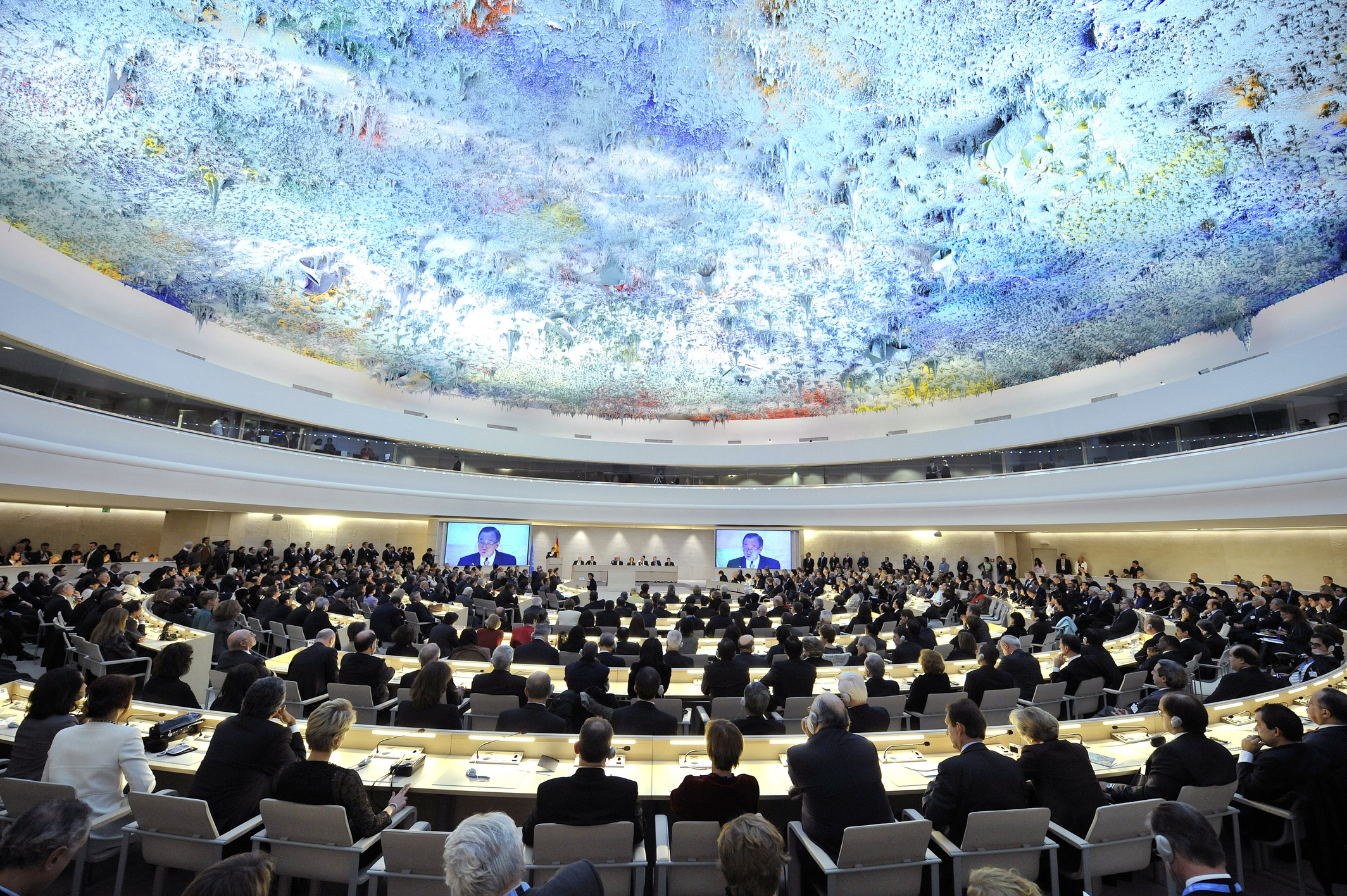
Understanding the UPR
Every five years, all 193 UN Member States undergo a Universal Periodic Review (UPR) of their human rights record. Established in 2006, the UPR is not a court and has no binding enforcement. Instead, its strength lies in transparency and universality. Every country participates. Every country is evaluated.
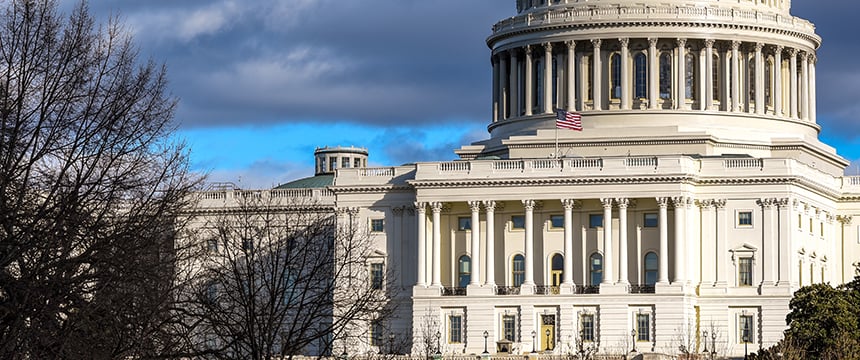
For the United States, the UPR is more than a mirror of domestic progress. It is also a forum to hold others to account – from governments restricting free speech to regimes targeting minorities. Washington’s participation presents an opportunity to both shape the system and the credibility to challenge others.
The UPR is more than a mirror of domestic progress. Washington’s participation presents an opportunity to shape the system and the credibility to challenge others.
How It Works
The process is straightforward. Each country submits its own national report. The UN compiles expert findings and civil society input in response. A panel of three peers leads a dialogue, producing an outcome report of recommendations, as well as the state’s responses. Governments can accept or note those recommendations, creating a public record of commitments.
As Juliette De Rivero, Chief of the UPR Branch at the UN Human Rights Office, explains: “It’s not about targeting offenders. It’s about recognizing that all states have challenges they need to confront – that they want to confront.”
“All states have challenges they need to confront – that they want to confront.”
Juliette De Rivero, Chief of the UPR Branch at the UN Human Rights Office
For countries, engagement in the UPR process signals credibility, compliance and strengthens standing in wider UN debates. “The fact is that states care deeply about how they are viewed by others,” De Rivero adds.
Real-World Impact
Critics sometimes dismiss the UPR as symbolic. In practice, it has spurred critical reforms – from criminal justice changes in Liberia and Zambia to a White House meeting on U.S. human rights implementation that Martha Davis of Northeastern University calls “a first-of-its-kind after decades of advocacy.”
For U.S. advocates, the UPR is a bridge. “Hundreds of groups prepare for it. We meet with communities, distill issues and put them on the table in Washington. It gives voice, even when fixes aren’t immediate,” Davis explains.
That bridge matters because, as ACLU’s Jamil Dakwar notes, “the UPR was designed to help governments reflect on protections at home and identify areas to improve for the benefit of everyone.”
De Rivero underscores the same point, calling the UPR one of the few global forums where government and civil society “share the same table.”
Dakwar, Director of the ACLU Human Rights Program, highlights why this distinction has special weight in U.S. debates: “Here, we often talk about civil rights, which are defined by national and state law. Human rights are more holistic. It’s this wider framework the UPR provides that helps close gaps in protecting all people.”
“The UPR was designed to help governments reflect on protections at home and identify areas to improve for the benefit of everyone.”
Jamil Dakwar, Director of the ACLU Human Rights Program
Strengths and Tensions
There’s no question there are tensions. Some Americans are uneasy with foreign governments weighing in on U.S. policy, while others see limited value in a process without strong enforcement. But those critiques overlook the purpose of the review. The UPR is not about Geneva dictating to any government; it is about dialogue and accountability.
Dakwar describes a bigger picture: “The UPR is a chance to reflect on how our own laws and constitutional commitments are being fulfilled.” At its best, it gives the U.S. a chance to show how Americans live up to the promise of our expressed national values.
“The UPR is a chance to reflect on how our own laws and constitutional commitments are being fulfilled.”
Jamil Dakwar
Universality at Risk
Since 2006, every country has completed three reviews. Israel briefly stepped backed but returned, and Nicaragua withdrew only after finishing its fourth review. No state has ever flatly refused. Now the U.S. risks becoming the first.
“If the U.S. persists, it will be the first country not to undergo its review,” warns De Rivero. “This moment is unprecedented,” Dakwar adds. The price would be high: reputational harm, diminished credibility as a human rights leader and a weaker hand in challenging others.
With official participation in doubt, American civil society groups are organizing a People’s UPR later this month. “It’s an innovative, refreshing forum,” Dakwar explains. “It shifts attention to spaces where directly affected people can testify and demand action. A place to be activated.”
Why It Matters
For the U.S., participation in the UPR signals confidence and leadership; opting out signals the opposite. As De Rivero puts it: “It’s not about perfection. It’s about persistence.” At stake are real people – farmworkers, people with disabilities, communities demanding safe water and functioning schools – for whom the UPR is a lever for visibility and progress.
But the stakes are bigger than the process itself. In a moment of heightened domestic tensions and public debate about the role of government, submitting to international scrutiny can feel like a distraction. Yet refusing engagement risks making the U.S. appear insulated. The paradox is unavoidable: if we walk away, we undercut our ability to credibly champion human rights abroad; if we stay, we accept uncomfortable scrutiny, but demonstrate the persistence and self-correction that define democratic leadership.
In an era of growing division and distrust, the harder path – showing up, being scrutinized, insisting on accountability – is the better one.
If we walk away, we undercut our ability to credibly champion human rights abroad. Withdrawal doesn’t just weaken the UPR, it weakens America.