Share
Array
(
    [0] => WP_Post Object
        (
            [ID] => 16988
            [post_author] => 5
            [post_date] => 2026-03-03 13:28:03
            [post_date_gmt] => 2026-03-03 13:28:03
            [post_content] => As military strikes ripple across Iran and the wider Middle East, a dangerous question hangs in the air: what happens if a nuclear facility is caught in the crossfire?

So far, the world’s nuclear watchdog says the region has avoided the worst-case scenario. Radiation monitoring systems have detected “no elevation of radiation levels above the usual background levels” in countries bordering Iran, according to Rafael Grossi, head of the International Atomic Energy Agency.
Radiation monitoring systems have detected “no elevation of radiation levels above the usual background levels” in countries bordering Iran.
Just as important, Grossi told the IAEA Board of Governors in Vienna on Monday, March 2, inspectors currently have “no indication that any of the nuclear installations… have been damaged or hit.”

But the margin for error is thin.

Even without confirmed damage to nuclear infrastructure, Grossi warned that the risks posed by an expanding regional conflict are serious. Military strikes near nuclear facilities, he cautioned, could quickly escalate into something far more dangerous.

“The situation today is very concerning,” Grossi added, warning that a radiological release with serious consequences cannot be ruled out if the conflict spreads or critical infrastructure is damaged.
Monitoring the Situation
The Agency’s Incident and Emergency Centre has been activated and is now operating continuously, collecting real-time data and coordinating with regional safety networks as the conflict unfolds.

While satellite imagery shows activity around several Iranian nuclear sites, Grossi emphasized that nothing observed so far resembles previous confirmed attacks on nuclear facilities in the region.

At the same time, the IAEA has not yet been able to fully restore routine technical communications with Iran’s nuclear regulatory authorities through its emergency channels. Diplomatic contacts remain intact, but the regular exchange of safety data has been disrupted. The Agency says it continues working to restore those technical lines.
The IAEA has not yet been able to fully restore routine technical communications with Iran’s nuclear regulatory authorities through its emergency channels.
Diplomacy: "Hard, Never Impossible"
Even as the military situation evolves, Grossi stressed that diplomacy remains the only durable solution to the nuclear dispute surrounding Iran’s program.

“The lasting solution to this long-existing discord lies on the diplomatic table,” he said. “Diplomacy is hard, but it is never impossible. Nuclear diplomacy is even harder, but it is never impossible.”

In a press conference following Monday’s Board meeting, Grossi noted that he recently participated in consultations aimed at resolving tensions around Iran’s nuclear program, providing IAEA’s technical expertise to negotiators. Although those talks did not produce an agreement, the Agency stands ready to support future diplomatic efforts whenever they resume.

“It is not a matter of if, but of when we will again gather at that diplomatic table,” Grossi added.
“It is not a matter of if, but of when we will again gather at that diplomatic table."
Uncertainty Around Iran’s Nuclear Program
Separately, an IAEA report released days before the meeting highlighted continuing uncertainty about Iran’s nuclear activities following the 12-day war between Iran and Israel in June 2025.

Because inspectors have not been granted access to several facilities, the agency says it “cannot provide any information on the current size, composition or whereabouts of the stockpile of enriched uranium in Iran,” warning that the “loss of continuity of knowledge… needs to be addressed with the utmost urgency.”

The IAEA says it “cannot provide any information on the current size, composition or whereabouts of the stockpile of enriched uranium in Iran.”

Under the Treaty on the Non-Proliferation of Nuclear Weapons (NPT), Iran is obligated to cooperate with inspectors, though Tehran curtailed cooperation following the war.
According to IAEA reports, Iran operates four declared enrichment facilities and currently possesses about 972 pounds of uranium enriched to 60 percent purity, close to weapons-grade levels at 90 percent. Grossi warned that, if further enriched, the stockpile could theoretically provide enough fissile material for as many as ten nuclear weapons, though he stressed that does not mean Iran currently possesses a bomb.
With access limited, the IAEA has increasingly relied on satellite imagery. Recent images of the Isfahan nuclear complex – just over 200 miles southeast of Tehran – show “regular vehicular activity” near a tunnel system believed to store enriched uranium.
The report notes that Iran did allow inspectors to visit several unaffected facilities at least once since June 2025, with the exception of a power plant under construction at Karun.

Regional Nuclear Infrastructure
The broader regional context also raises the stakes.

The Middle East now includes several countries with nuclear power or research capabilities. The United Arab Emirates operates four nuclear reactors, while Jordan and Syria maintain research reactors. Israel, not a party to the NPT, is widely believed to possess over 90 nuclear warheads, though the country neither acknowledges nor denies the existence of an arsenal. Other states in the region use nuclear materials for medical, industrial and research purposes.

In this environment, longstanding IAEA resolutions warning against attacks on nuclear facilities carry renewed relevance. Damage to reactors, enrichment plants or storage sites could produce cross-border radiological consequences.
IAEA’s Technical Role
It is critical to underscore that the IAEA’s role is technical, not political.

Decisions about military action are made by governments based on their own intelligence and national security assessments. The IAEA’s mandate is to verify nuclear material, monitor safeguards compliance and assess nuclear safety risks.
The IAEA’s role is technical, not political... to verify nuclear material, monitor safeguards compliance and assess nuclear safety risks.
What Comes Next
The IAEA, Grossi said, will remain on alert. The Agency will “continue to monitor the situation” and stands ready to support governments if nuclear safety or security is threatened.

“What I can assure you,” he said, “is that the IAEA is there – keeping the international community informed and ready to react immediately if a breach in nuclear safety occurs.”

Update on March 4: Since the publication of this article on March 3, the IAEA confirmed the Natanz nuclear enrichment facility, located outside of Qom, Iran, suffered “some damage” at entrance buildings to the underground fuel enrichment plant. A statement issued on Wednesday, March 4, stressed that, “No radiological consequence expected and no additional impact detected at FEP itself.” The Natanz facility was among the sites severely damaged during the 12-day war between Iran and Israel in 2025.

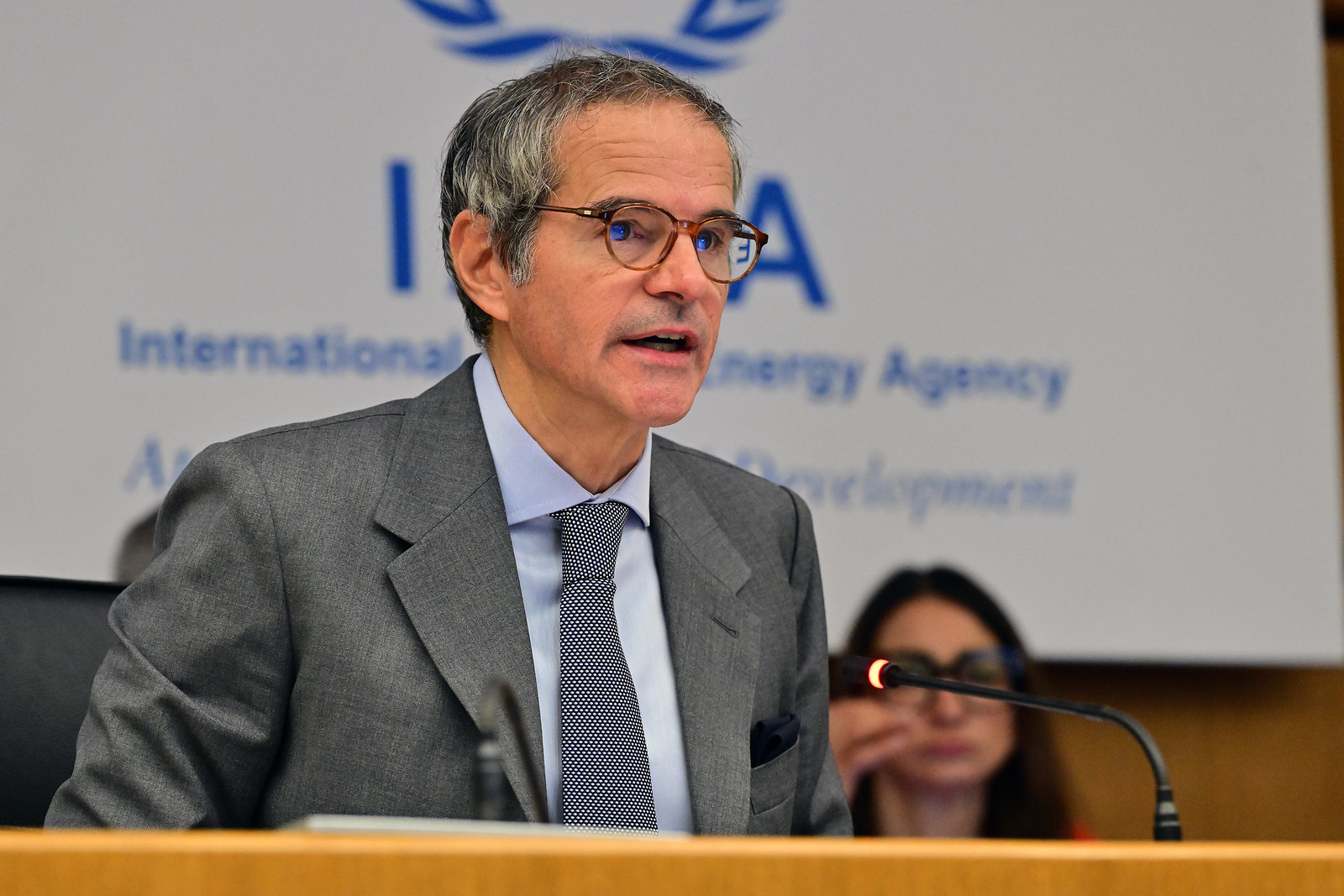
Photo: Rafael Mariano Grossi, IAEA Director General, delivers opening remarks at the 1795th Board of Governors meeting in Vienna on March 2, 2026; credit to Dean Calma, IAEA
            [post_title] => UN Nuclear Agency Warns of Risks as Fighting Escalates in Iran
            [post_excerpt] => IAEA Director-General Rafael Grossi is warning that the escalating conflict in Iran raises the risk of a dangerous nuclear incident.
            [post_status] => publish
            [comment_status] => closed
            [ping_status] => closed
            [post_password] =>
            [post_name] => un-nuclear-watchdog-warns-of-risks-as-fighting-escalates-in-iran
            [to_ping] =>
            [pinged] =>
            [post_modified] => 2026-03-04 14:43:50
            [post_modified_gmt] => 2026-03-04 14:43:50
            [post_content_filtered] =>
            [post_parent] => 0
            [guid] => https://betterworldcampaign.org/?p=16988
            [menu_order] => 0
            [post_type] => post
            [post_mime_type] =>
            [comment_count] => 0
            [filter] => raw
        )

    [1] => WP_Post Object
        (
            [ID] => 16519
            [post_author] => 5
            [post_date] => 2026-01-13 15:36:59
            [post_date_gmt] => 2026-01-13 15:36:59
            [post_content] => While Operation Absolute Resolve put Venezuela in the global spotlight, it also ignited a broader debate among diplomats and legal experts about the United Nations Charter – its origins, its limits and what happens when those limits are tested.

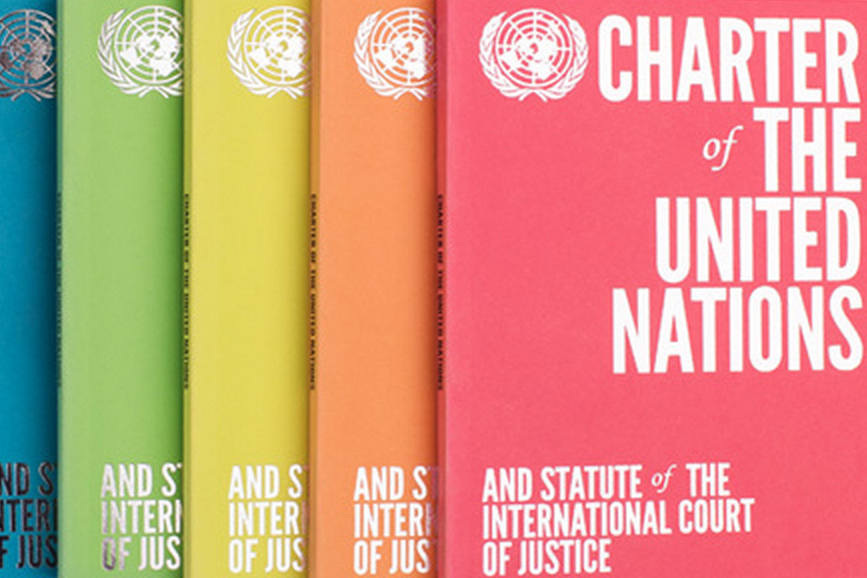
To understand what’s at stake, it helps to see the Charter for what it was designed to be: a kind of international constitution that helps nations work well together.
National Security at a Global Scale
Adopted in 1945, the UN Charter is the founding document of the United Nations, and its roots are deeply American. President Franklin D. Roosevelt helped shape its principles through the 1941 Atlantic Charter with Winston Churchill, envisioning a postwar world built on collective security rather than perpetual war.

When the Charter was presented in San Francisco, the U.S. Senate ratified it by an overwhelming 89-2 vote. This was not idealistic globalism, but calculated national security strategy – designed to create rules strong enough to restrain aggression before U.S. troops were pulled into another catastrophic conflict.
The UN Charter was national security strategy designed to restrain aggression before U.S. troops were pulled into another catastrophic conflict.
Legally, the Charter is a treaty incorporated into U.S. law through Senate ratification and the President’s signature. Functionally, it sets out shared rules for how states interact, defines strict limits on the use of military force and creates institutions (the Security Council, the General Assembly and the International Court of Justice) to manage disputes.
The Rule Everyone’s Talking About
Lately, when people talk about “violating the Charter,” they’re often referring to Article 2(4), which states: “All Members shall refrain in their international relations from the threat or use of force against the territorial integrity or political independence of any state, or in any other manner inconsistent with the Purposes of the United Nations.”

In plain terms: respect borders.

Not every border incident qualifies as a violation. Accidental or isolated infractions, or limited law enforcement actions that breach sovereignty, may cross physical – but not legal – thresholds. Article 2(4) is typically triggered when military force becomes serious: bombing another state’s infrastructure, engaging another state’s armed forces or occupying another territory.
When Force Is Allowed
When that line is crossed, the Charter permits military action in a couple circumstances.
Article 51
First: self-defense, preserved in Article 51.

When sovereignty is violated by an armed attack, a state may respond, but the response must be necessary and proportionate. Collective self-defense – when other nations join in – requires a request from the attacked state so as not to violate sovereignty themselves.

In recent years, Article 51 has become increasingly central and controversial. Some states argue self-defense is lawful only after an actual attack occurs. Others, led largely by the U.S. and its allies, argue that force may also be justified in cases of imminent threat and against non-state actors operating with a state’s protection. Since 2021, Article 51 has been invoked at least 78 times.

The Security Council plays a critical role here, as Article 51 requires states to report self-defense actions. These reports help other governments assess legality and shape international law through precedent.
Chapter VII
Second: Security Council authorization under Chapter VII.

When the Council determines that a situation threatens international peace – not just one country’s security – it can authorize measures that may include military force as a last resort, usually beginning with political and economic tools. Any action must still be necessary, proportionate and aimed at restoring peace and security.

Historically, the Council was cautious about explicitly invoking Chapter VII. Its intent was often inferred from language and context. The first explicit Chapter VII action appeared in 1968 during debates over Southern Rhodesia, reflecting political divisions over sanctions and force.

In recent decades, practice has become more mixed. Some resolutions rely on Chapter VII without naming it. Others cite it directly to avoid ambiguity. At times, the language is used mainly for political signaling, while some Chapter VII resolutions include non-mandatory terms like “urges” or “calls upon.” The result is ongoing debate over which decisions are legally binding and how far Chapter VII authority extends.
What Happens When a Violation Occurs?
The UN has no global police force, so Charter violations are addressed through diplomacy, sanctions, international courts and political pressure – both through UN bodies and individual states.

The process usually begins with non-military tools authorized under Article 41, including economic sanctions, asset freezes, travel bans, arms embargoes and diplomatic restrictions. The Council can also establish monitoring committees, expert panels and, in rare cases, international tribunals, such as those created after the wars in the former Yugoslavia and Rwanda.

If non-military measures fail, Chapter VII allows for collective military action, though this is used sparingly. Even then, enforcement depends less on a standing UN force, which the UN lacks –peacekeepers are contributed voluntarily by Member States – and more on the willingness of countries to act. States implement sanctions through their own laws, while UN committees monitor compliance and report back to the Council. The system works best when major powers are aligned. When permanent members disagree or use their veto power, enforcement can stall.

In the end, the Charter provides the legal tools. Political will determines how far they go.
Humanitarian Intervention
The moral case for using force to stop atrocities is powerful. The legal case gets a bit more contested.

After Rwanda and Kosovo, the UN embraced the Responsibility to Protect framework, or R2P – but it also reaffirmed one core rule: only the Security Council can authorize the use of force. A handful of countries still argue for a narrow right to intervene when catastrophe looms. Most remain wary, concerned that “humanitarian” can too easily become a cover for politics.

R2P fits squarely within the Charter’s collective security system. It says states must protect their own people from genocide, war crimes, ethnic cleansing and crimes against humanity. If they fail, the international community should try diplomacy and humanitarian pressure first. If that isn’t enough, Chapter VII gives the Security Council the authority to act – including, if necessary, with force.
Why Justification Matters
One of the Charter’s most important effects is that it forces governments to explain themselves. Even when states use force, they almost always justify their actions in Charter terms – self-defense, consent or collective security.

Those explanations may be contested, but the act of justifying matters. It reinforces the idea that rules exist, legitimacy flows through them and precedent shapes future behavior.
Any Gray Areas?
Like all fields of law, yes.

Modern conflicts complicate the picture. Large-scale terrorist attacks by non-state actors may qualify as armed attacks, allowing self-defense if there’s evidence another state provided material or tacit support. But legal experts warn that lowering the threshold too far risks turning the Charter into a permissive system rather than a restraining one.

Then there’s “violation by proxy,” a concept the International Court of Justice addressed in its landmark 1986 Nicaragua v. United States decision. The Court made clear that a state can violate the Charter’s prohibition on force even without sending its own troops across a border. Providing critical support to armed groups – including arming, training or directing insurgents – can amount to an unlawful “armed attack.” In other words: you don’t need boots on the ground to cross the line.
Why the Charter Still Matters
Like all living constitutions, the UN Charter faces the challenges of its time and must continue to adapt.

But the bottom line remains the same: the Charter matters. Because at its core, it's designed to raise the political cost of aggression, narrow the legal justifications for force and preserve collective security as the default.
The Charter raises the political cost of aggression, narrows the legal justifications for force and preserves collective security as the default.
            [post_title] => Understanding the UN Charter: Article 2 and the Rules that Shape Global Security
            [post_excerpt] => With the United Nations Charter making news, we break down the significance of Article 2 and why it remains a cornerstone of U.S. national security, global stability and the rules-based international order.
            [post_status] => publish
            [comment_status] => closed
            [ping_status] => closed
            [post_password] =>
            [post_name] => what-is-the-united-nations-chapter-and-article-2
            [to_ping] =>
            [pinged] =>
            [post_modified] => 2026-01-13 17:26:37
            [post_modified_gmt] => 2026-01-13 17:26:37
            [post_content_filtered] =>
            [post_parent] => 0
            [guid] => https://betterworldcampaign.org/?p=16519
            [menu_order] => 0
            [post_type] => post
            [post_mime_type] =>
            [comment_count] => 0
            [filter] => raw
        )

    [2] => WP_Post Object
        (
            [ID] => 16945
            [post_author] => 5
            [post_date] => 2026-02-28 18:20:45
            [post_date_gmt] => 2026-02-28 18:20:45
            [post_content] => This is an evolving situation. Updates will be provided as new information is available.
In the wake of coordinated U.S. and Israeli attacks on Iran on February 28, 2026, which struck military sites and senior leadership of the Iranian regime, tensions throughout the Middle East are rapidly escalating. Iran has responded with a wave of drone and missile attacks across the region, with strikes verified in Israel and several Gulf states.

At the request of French President Emmanuel Macron, the UN Security Council convened an emergency session just hours after the attacks began. The meeting offered a snapshot of global reaction: a divided international response marked by caution from allies, sharp criticism from rivals and widespread concern about the risk of regional war.
Washington’s Position
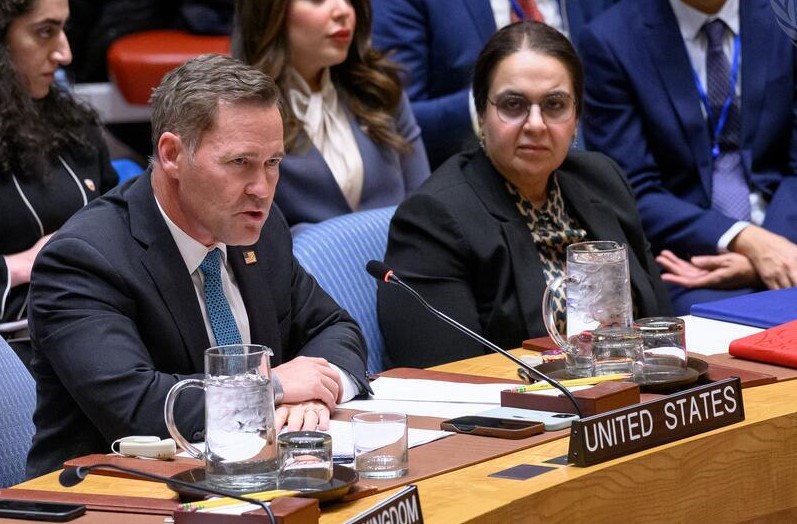
U.S. Ambassador Mike Waltz defended the operation as a necessary response to long-standing security threats posed by Iran. (Read his unabridged remarks here.)

“The most fundamental duty of any sovereign government is the protection of its people,” he stressed. Waltz repeated the words of President Trump, who released a video earlier in the day, saying, “To the proud, great people of Iran. I saw tonight that the hour of your freedom is at hand.”
“The most fundamental duty of any sovereign government is the protection of its people.”
U.S. Ambassador Mike Waltz

Waltz reiterated that the strikes were designed to dismantle ballistic missile capabilities, degrade naval assets used to disrupt international shipping and weaken networks supporting proxy militias, specifically that of the Houthis, Hezbollah and Hamas. Preventing Iran from acquiring a nuclear weapon, he said, was the central objective.

“No responsible nation can ignore persistent aggression and violence,” Waltz told the Council, citing decades of attacks on U.S. personnel, allies and maritime commerce.

He closed by saying, “Peace is preserved through strength in the face of terror. History has taught us that the cost of inaction is far greater than the burden of decisive action, and our President, President Trump, has taken that decisive action today.”

Israel’s ambassador, Danny Danon, echoed Waltz's position, describing the operation as a last resort after repeated diplomatic efforts stalled.

“Israel stands before you today… to confront and stop an existential threat before it became irreversible,” Danon said.

Both governments framed their actions as lawful self-defense under Article 51 of the UN Charter.
Iran’s Response
Iran’s ambassador, Amir-Saeid Iravani, rejected those claims, calling the strikes “an unprovoked and premeditated aggression.”

“This is not only an act of aggression; it is a war crime and a crime against humanity,” Iravani said, accusing the U.S. and Israel of deliberately targeting civilian areas.

Iravani argued that self-defense claims lack legal foundation and insisted Iran’s retaliatory strikes were a legitimate response, similarly citing Article 51. He also claimed Western countries were applying a “double standard” by condemning Iran’s response while avoiding criticism of the initial strikes.
“A Grave Threat”
Secretary-General António Guterres focused on regional reverberation. At the time of the meeting, Iran’s response included retaliatory rockets targeting Bahrain, Saudi Arabia, Qatar, the United Arab Emirates, Kuwait and Jordan. Airspace closures, internet blackouts and disruptions to shipping through the Strait of Hormuz underscored the risk of global economic fallout, while reports of civilian casualties intensified international concern.

“We are witnessing a grave threat to international peace and security,” Guterres told the Council in his opening statement, warning that the conflict could ignite “a chain of events that no one can control in the most volatile region of the world.”

Perhaps most troubling for UN officials, the events occurred amid ongoing negotiations between Washington and Tehran mediated by Oman. Talks were expected to resume in Vienna in early March, but the situation casts doubt on whether those diplomatic channels will remain open.
Europe’s Balancing Act
France, Denmark, Greece, Latvia and the U.K. all expressed deep concern about escalation and civilian harm, with France, Germany and the U.K. issuing a joint statement condemning Iran for retaliatory attacks against neighbors in the Gulf.

France warned that the situation was “dangerous for everyone” and urged an immediate halt to hostilities, while criticizing Iran’s nuclear program and lack of cooperation with international inspectors.

The United Kingdom’s representative emphasized regional stability as the priority and condemned Iran’s retaliatory strikes across neighboring states. Underscoring they did not participate in the initial attacks, the ambassador did state that U.K. forces were “active and British planes in the sky... as part of coordinated regional defensive operations."

The overall tone suggested unease with the escalation coupled with reluctance to break with Washington.
Criticism from China and Russia
In contrast, China and Russia sharply condemned the strikes.

China described the operation as “brazen,” emphasizing that Iran’s sovereignty “must be respected” and urging an immediate cessation of military action.

Russia called the attacks an “unprovoked act of armed aggression against a sovereign and independent UN Member State,” warning that they risked triggering a humanitarian and economic catastrophe.

Pakistan also condemned the strikes as violations of international law while simultaneously criticizing Iran’s attacks on Gulf states – a position reflecting concern about alignment with either side.

Several Global South countries focused primarily on civilian protection and the need to uphold principles of the UN Charter, warning that reprisals were replacing diplomacy.
Gulf States Offer Nuanced View
Representatives from Gulf countries emphasized that Iran’s response had expanded the conflict far beyond its original participants.

Bahrain described missile strikes on civilian infrastructure and residential areas as “a grave threat to international and regional peace and security.” As with other Arab states, they cautioned that the attacks could disrupt air navigation, maritime trade and energy flows.

Representing the League of Arab States, Ambassador Abdulaziz Al-Shamsi linked the crisis to the broader Israeli-Palestinian conflict, warning that the “Arab-Israeli conflict has expanded into a full-scale regional war.” He accused Israel of escalating militarily to “prevent the establishment of an independent Palestinian state.”
Fear of Wider War and Calls for Diplomacy
Despite sharp divisions, one theme united nearly all speakers: alarm at the possibility of regional war.

Diplomats warned of cascading risks, including escalation involving additional states, proxy warfare and humanitarian consequences for civilians. “Sustainable peace can only be achieved through diplomacy, not through force,” Somalia’s representative said on behalf of several African members.

Even countries critical of Iran’s behavior insisted that negotiations remain the only viable long-term solution.
What Comes Next
The Council took no formal action – an anticipated outcome given the United States’ veto power as a permanent member. Still, the debate underscored allies’ alignment with Washington against the backdrop of calls for de-escalation to prevent a regional war.
“Peace is preserved through strength in the face of terror. History has taught us that the cost of inaction is far greater than the burden of decisive action."
U.S. Ambassador Mike Waltz


Representatives Present (listed in order of formal remarks)
- UN Secretary-General António Guterres
- France: Ambassador Jérôme Bonnafont
- Bahrain: Ambassador Jamal Fares Al-Ruwaie
- Russia: Ambassador Vassily Nebenzia
- China: Ambassador Fu Cong
- Colombia: Ambassador Leonor Zalabata Torres
- U.S.: Ambassador Mike Waltz
- Denmark: Ambassador Christina Markus Lassen
- Pakistan: Ambassador Asim Iftikhar Ahmad
- Greece: Ambassador Aglaia Balta
- Somalia: Deputy Ambassador Mohamed Rabi Yusuf
- Panama: Ambassador Eloy Alfaro De Alba
- Latvia: Ambassador Sanita Pavļuta-Deslandes
- U.K.: Ambassador James Kariuki (Security Council President)
- Iran: Ambassador Amir-Saeid Iravani
- Israel: Ambassador Danny Danon
- United Arab Emirates: Abdulaziz Nasser Al-Shamsi (on behalf of the League of Arab States)
Remarks from the Secretary-General
Prior to the meeting, UN Secretary-General António Guterres issued the following statement:
I condemn today’s military escalation in the Middle East. The use of force by the United States and Israel against Iran, and the subsequent retaliation by Iran across the region, undermine international peace and security.
All Member States must respect their obligations under international law, including the Charter of the United Nations. The Charter clearly prohibits “the threat of the use of force against the territorial integrity or political independence of any state, or in any other manner inconsistent with the Purposes of the United Nations.”
I call for an immediate cessation of hostilities and de-escalation. Failing to do so risks a wider regional conflict with grave consequences for civilians and regional stability. I strongly encourage all parties to return immediately to the negotiating table.
I reiterate that there is no viable alternative to the peaceful settlement of international disputes, in full accordance with international law, including the UN Charter. The Charter provides the foundation for the maintenance of international peace and security.
Related Links
[post_title] => UN Security Council Meets in Emergency Session on Crisis in the Middle East
[post_excerpt] => The UN Security Council convened in an emergency session after U.S.–Israeli strikes on Iran triggered retaliatory attacks across the Middle East, raising fears of a wider regional war. Here’s how the meeting unfolded.
[post_status] => publish
[comment_status] => closed
[ping_status] => closed
[post_password] =>
[post_name] => un-security-council-convenes-emergency-session-on-crisis-in-the-middle-east
[to_ping] =>
[pinged] =>
[post_modified] => 2026-03-04 13:09:17
[post_modified_gmt] => 2026-03-04 13:09:17
[post_content_filtered] =>
[post_parent] => 0
[guid] => https://betterworldcampaign.org/?p=16945
[menu_order] => 0
[post_type] => post
[post_mime_type] =>
[comment_count] => 0
[filter] => raw
)
[3] => WP_Post Object
(
[ID] => 16653
[post_author] => 5
[post_date] => 2026-02-19 00:48:22
[post_date_gmt] => 2026-02-19 00:48:22
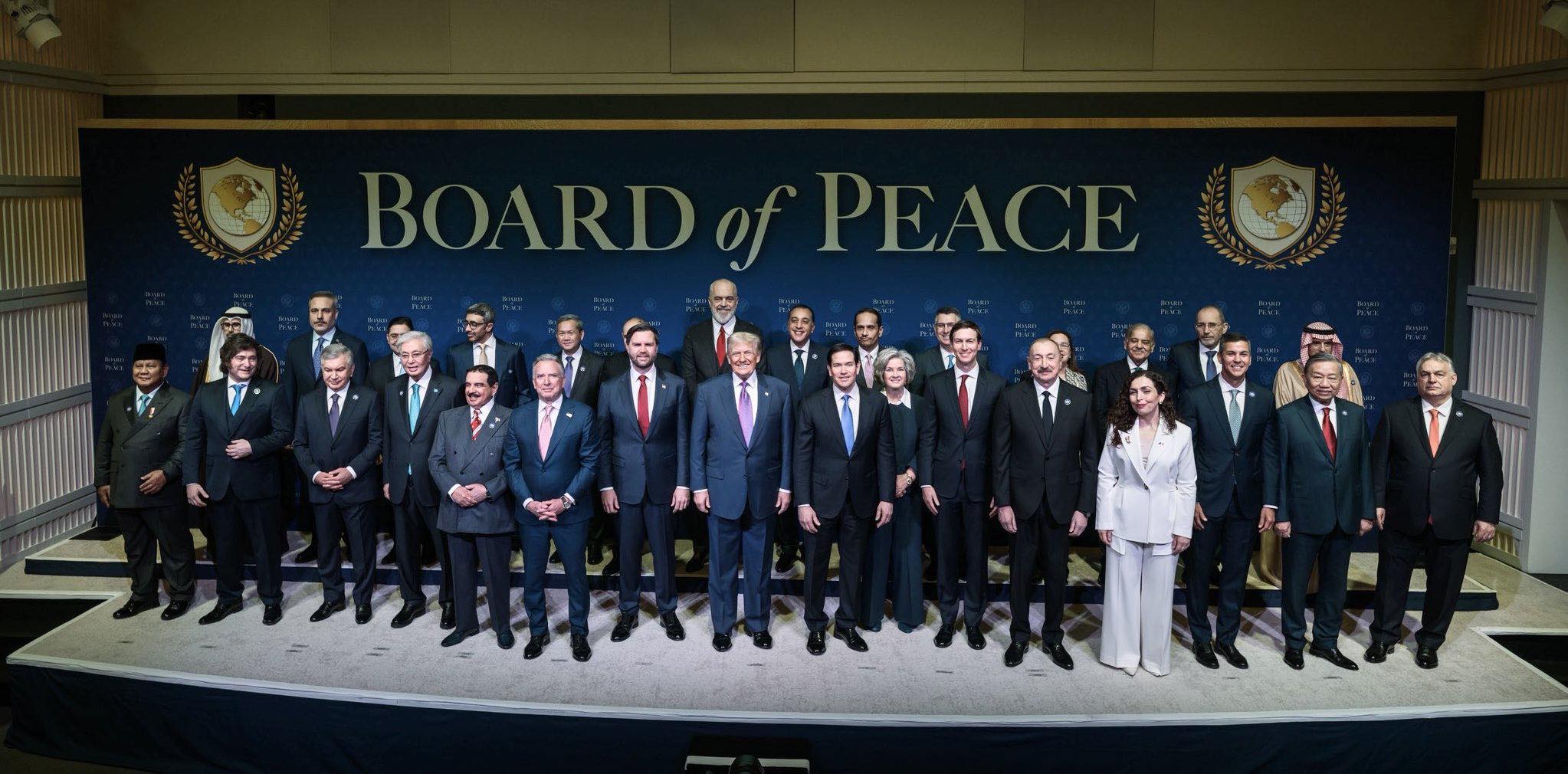
[post_content] => This piece was originally published on January 30, 2026, and is being updated regularly. The inaugural meeting of the Board of Peace was held at the Donald Trump Institute of Peace on February 19, 2026. The meeting can be viewed in its entirety.
A new international body known as the Board of Peace was formally launched in January, following a November vote by the UN Security Council through Resolution 2803 that welcomed a U.S.-brokered, 20-point framework to end the war in Gaza. The initiative gained decisive momentum on January 22, when President Trump signed the Board’s charter at the 57th World Economic Forum in Davos.
On February 19, President Trump convened the first meeting of the new Board in Washington, DC, announcing billions in pledges from select member countries to rebuild Gaza, while offering few details on how this will be achieved in practice. In addition, Secretary of State Marco Rubio suggested that the Board’s scope may expand, saying, “We hope that this can serve as a model for other complex and difficult situations, so they can be solved in the same way.”
Supporters of the Board describe it as a nimble alternative to collective action by the Security Council to facilitate reconstruction planning in Gaza. Skeptics, including close U.S. allies such as France and the United Kingdom, have raised concerns that the initiative could sidestep the existing multilateral system or be used to channel funding away from broadly supported UN organizations. For example, a spokesperson for France’s foreign ministry recently highlighted the “ambiguity” of the board’s scope, stating that it must “refocus on the situation in Gaza.”
As of now, there’s still much we do not know, and we will continue to fine-tune our analysis in the weeks and months ahead. But for now, let’s look beyond the headlines to examine the Board of Peace on its own legal and institutional terms.
What the Board of Peace Is
At its core, the Board is a selective coalition of willing states organized outside the UN system. While its establishment was endorsed by the UN Security Council -specifically as a “transitional administration” in Gaza for the purpose of coordinating reconstruction efforts - that endorsement does not extend to any operational plans or its governance.
Unlike the United Nations, it is not a universal body and does not rely on broad multilateral consensus to act. Instead, it is structured as a stand-alone organization designed to move quickly among a limited group of aligned participants.
The Board’s governance model is explicitly centralized. Its charter establishes a chairman-centered structure under which President Trump, as Chairman, holds sweeping authority to invite or exclude members, break ties and approve or veto all Board resolutions.
Membership is invitation-only, with three-year terms that are renewable at the Chairman’s discretion rather than through collective decision-making.
Financially, the Board relies entirely on voluntary contributions. Long-term participation currently requires a reported $1 billion financial commitment, reinforcing its character as a high-threshold, opt-in forum rather than an inclusive institution.
While its immediate focus is intended to be the Gaza ceasefire framework, the charter grants the Board authority to expand to address conflicts in which it determines that stability or lawful governance is at risk. Of note, the current charter for the board makes no direct mention of Gaza.
Is the Board Replacing the UN or the Security Council?
This is a key question, which is still not answerable, in part because of the conflicting signals sent from the Administration. During the inaugural meeting of the Board, President Trump suggested it may one day supersede the UN, saying, in the future, "the Board of Peace is going to almost be looking over the United Nations and making sure it runs properly.” Nevertheless, the President also spoke positively about the global body, noting, “We’re going to make sure the United Nations is viable,” and promising to “help them, moneywise.”
More broadly, it is important to know that, although the Board of Peace is often discussed in the same breath as the Security Council, the two bodies operate on fundamentally different legal foundations.
The Security Council derives its authority from the UN Charter, a treaty ratified by UN Member States that explicitly assigns it primary responsibility for the maintenance of international peace and security. That mandate was conferred collectively by the international community and cannot be replicated by a separate organization asserting a similar mission.
Equally important is the question of binding authority. Under Article 25 of the UN Charter, UN Member States are obligated to carry out decisions of the Security Council. The Board of Peace has no comparable mechanism. Its decisions apply only to those states that choose to participate and carry no legal force for non-members.
The distinction becomes most consequential when it comes to enforcement. Only the Security Council possesses unique Chapter VII powers, including the authority to impose sanctions and authorize the use of force in ways that are recognized across jurisdictions.
The Board of Peace, by contrast, can coordinate political positions and financial support but cannot create enforcement regimes that bind the international system as a whole.
The Takeaway: Coordination Versus Authority
Read on its own terms, the Board of Peace is best understood as a coordination platform – a mechanism for like-minded states to act quickly around a specific political objective, initially Gaza, without the procedural constraints of universal multilateralism. In that sense, it could theoretically offer speed and flexibility where the UN system is deliberately cautious.
What it cannot offer is legal legitimacy on a global scale. The ability to authorize peacekeeping missions, impose sanctions that endure across changing governments and anchor ceasefires in recognized international law remains exclusive to the UN Security Council. These are not abstract distinctions. They are the reason UN-backed decisions carry weight beyond the moment and beyond the membership of any single coalition.
Bottom line? If the Board of Peace succeeds in its mission, it may ultimately complement multilateralism by functioning as a rapid-response forum. As it currently stands, however, it cannot replace the foundations of a system grounded in treaty law and universal membership.
Current Membership
Chairman
President Donald J. Trump
Board of Peace Members
60 invited, seats are represented by heads of state
- Argentina
- Armenia
- Azerbaijan
- Bahrain
- Bulgaria
- El Salvador
- Hungary
- Indonesia
- Jordan
- Kazakhstan
- Kosovo
- Mongolia
- Morocco
- Pakistan
- Paraguay
- Qatar
- Saudi Arabia
- Turkey
- United Arab Emirates
- United States
- Uzbekistan
Focused on diplomacy and investment
- Nickolay Mladenov
- Marco Rubio
- Steve Witkoff
- Jared Kushner
- Tony Blair
- Marc Rowan
- Ajay Banga
- Robert Gabriel, Jr.
Directs the National Committee for the Administration of Gaza
- Steve Witkoff
- Jared Kushner
- Hakan Fidan
- Ali al-Thawadi
- Hassan Rashad
- Tony Blair
- Marc Rowan
- Reem Al-Hashimy
- Nickolay Mladenov
- Yakir Gabay
- Sigrid Kaag
[post_title] => The Board of Peace: What We Know About Its Role, Reach and Limits
[post_excerpt] => The new Board of Peace was created through UN Security Council Resolution 2803 to support Gaza’s reconstruction. Here’s what we know so far.
[post_status] => publish
[comment_status] => closed
[ping_status] => closed
[post_password] =>
[post_name] => the-latest-on-the-board-of-peace-what-we-know
[to_ping] =>
[pinged] =>
[post_modified] => 2026-03-04 13:07:36
[post_modified_gmt] => 2026-03-04 13:07:36
[post_content_filtered] =>
[post_parent] => 0
[guid] => https://betterworldcampaign.org/?p=16653
[menu_order] => 0
[post_type] => post
[post_mime_type] =>
[comment_count] => 0
[filter] => raw
)
)
MIDDLE EAST DEVELOPMENTS
IAEA Director-General Rafael Grossi is warning that the escalating conflict in Iran raises the risk of a dangerous nuclear incident.
MIDDLE EAST DEVELOPMENTS
With the United Nations Charter making news, we break down the significance of Article 2 and why it remains a cornerstone of U.S. national security, global stability and the rules-based international order.
MIDDLE EAST DEVELOPMENTS
The UN Security Council convened in an emergency session after U.S.–Israeli strikes on Iran triggered retaliatory attacks across the Middle East, raising fears of a wider regional war. Here’s how the meeting unfolded.
MIDDLE EAST DEVELOPMENTS
The new Board of Peace was created through UN Security Council Resolution 2803 to support Gaza’s reconstruction. Here’s what we know so far.
Peace and Security
03/03/2026
Blog, Peace and Security
02/28/2026
Blog, Innovation
02/27/2026
Blog, Humanitarian Affairs
02/24/2026
Human Rights, Peace and Security
02/20/2026
Blog, Peace and Security
02/19/2026
Sign up for our monthly newsletter